MINISTRY OF ECOLOGY AND NATURAL RESOURCES
OF AZERBAIJAN REPUBLIC
OF AZERBAIJAN REPUBLIC
DEVELOPED WITH THE ASSISTANCE
OF THE CASPIAN ENVIRONMENT PROGRAM
2002
OF AZERBAIJAN REPUBLIC (NCAP)
|
The document was prepared by the National Working Group under the Ministry of Ecology and Natural Resources of Azerbaijan Republic with the assistance of the Caspian Environmental Program
Manager of the Group Ramiz Rzaev, Expertise Department Manager of MENR, M.A. of agriculture, an Honoured Agriculturist of Azerbaijan Republic
Group Members:
Sadagat Mamedova, the Manager of Bioresources Management Department of MENR
Larifa Guseynova, the Manager of the Complex Environmental Monitoring Department of the Caspian sea
Fuad Mardanli, D.M., Ministry of Health
Manaf Suleymanov, M.S. of Geography, Environmental Society of Azerbaijan
Talyat Kengerli, M.S., D.M., Institute of Geology of the NAS |
CONTENT
PAGES
1.1. Objectives of National Caspian Action Plan (NCAP) 5
1.2 Connection of NCAP with TDA and SAP 5
1.3 Connection of NCAP with PIPP 6
1.4 Methods of NCAP elaboration 6
1.6 Process of revision and amendment of NCAP 7
2.1 National political situation and institutional arrangements 8
2.1.1 Political and institutional arrangements 8
2.1.2 Institutional arrangements 8
2.1.3 Environmental legal and regulatory base 9
National Socio-Economic Situation 11
2.2.2 National Social – economic situation 13
2.3 Perspectives and tendencies of the next decade 16
3. Importance of Caspian Sea for the country 17
3.1 The catchment basin of the Caspian Sea 18
3.2 Zone of direct impact of Caspian 20
3.2.8 Quality of environment 23
3.2.10 Condition of the Caspian environment 28
3.2.11 Pollution of the Caspian sea 30
3.2.14 Biodiversity of the Sea (Azeri sector) 33
3.2.15 Biodiversity of coast 34
3.2.18 Specially Preserved Nature Territories 36
3.3 Perspectives of the Caspian impact 37
4. Main problems and their root causes 38
4.1 Main existing and emerging transboundary problems. 38
4.1.1 Decline in certain commercial fish stocks, including sturgeon: 38
4.1.2 Degradation of coastal landscapes and damage to coastal habitats 40
4.1.3 Threat to biodiversity 41
4.1.4 General deterioration of environmental quality 42
4.1.6 Contamination from oil and gas activities 44
4.2 Main existing and emerging national problems 45
4.2.1 Deterioration of human health 45
4.2.2 Damage of coastal infrastructure and amenities 46
4.3 Direct and root causes of the problems 47
5.1 Criteria of ranging of causes and determination of primary strategies and measures 48
5.2 Long term strategies of elimination of root causes 50
5.3 Urgent measures to eliminate root causes 51
6. Potential obstacles and ways of overcoming 52
6.1 Political and institutional obstacles 52
6.2 Social, cultural and economic obstacles 52
6.3 Inadequate human resources 53
7. The resource attraction strategy 54
8.1 Organization structure for implementing NCAP 57
Acronyms and abbreviations
List of priority programs and projects to NCAP
Caspian Sea has a great importance for the lives of people living by its coasts. Being the biggest inland sea in the world, the Caspian Sea ecosystem affects essentially the formation of ecosystems of the surrounding territories’. At present the intensity of contamination exceeds the ecological capacity of the Sea. Therefore the assessment of the ecological condition of Sea, survey of direct and indirect negative impacts on ecosystem, survey of ecosystem response to these impacts, and the study of the ecosystem’s capacity of adaptation to contamination are the necessary terms for further sustainable and rational usage of its resources.
A general objective of NCAP is to facilitate protection and rational use of natural resources of the Caspian Sea, to create favourable conditions for sustainable social and economic development of Azerbaijan Republic.
The present document contains the results of data analysis performed for evaluation of basic ecological and socio-economic impact on the Azeri sector of the Caspian Sea, including preparation of National Caspian Action Plan as a final result.
The tasks of the NCAP implementation include the identification of type and character of impacts on Caspian ecosystem on the territory of Azerbaijan, as well as determination of the sources and root and direct causes of impacts, analysis and determination of potential preventive, mitigating and rehabilitating measures.
The objectives of NCAP include improvement of environmental situation in the Azerbaijan sector of the Caspian Sea and adjacent coastal areas, reduction of adverse impact on human health, maintenance of vital functions of hydro and biospheres, participation of Azerbaijan in regional and international environmental activities.
Identification of national problems and sources of their root and direct causes, selection of necessary potential preventive and rehabilitation measures in NCAP were based on GEF guidelines on international waters. TDA was used as a technical basis, as it contains the analysis of transboundary problems of the Caspian region with the expert opinion on transboundary environmental issues. As the majority of the causes and problems are applicable to the entire Caspian region, i.e. have a transboundary nature, and proposed interventions and activities are too numerous, it is necessary to develop a tool for their prioritisation. As such, five EQO’s developed in TDA of CEP were used. EQO is a regional assessment of main environmental quality objectives of the Caspian.
Common problems, similar ways of using sea resources and the consequences of the use, their potential transboundary impact are a cause-effect parameter that is a key link between the NCAP and TDA.
The NCAP elaborated in accordance with the ecological and social policy of a country, based on a unified approach that describes the identical aspects of problems of the Azerbaijan part of the Caspian sea, will allow to prepare a unified Strategic Action Plan that will be based on NCAP of the littoral states and will focus on the transboundary issues. The positive mutual relationship between the SAP and NCAP’s is a strong basis for the Sustainable use of the Caspian sea by all littoral states.
Considering that the NCAP includes the ideas of TDA, national environmental action plans, targeted national programs and other documents the main proposals for investment projects will be taken directly from the NCAP. National and transboundary problems listed in the NCAP together with their root causes allow to assess the key ecological, social and economic impacts on the environment of the Caspian in Azerbaijan sector.
Basing on the assessment and selection of mitigative measures, the priority investment projects portfolio includes financing of projects that prevent environmental pollution, such as reducing discharge of untreated sewage or other pollutants in the Caspian sea and minimizing their damage; conservation of biodiversity; preventing further reduction of fish stocks; promoting sustainable use of natural resources of the coastal areas; supporting sustainable economic development; combating poverty and improving indicators of human health in the region.
As the majority of the causes and the problems are typical for the entire Caspian region, the selection of the investment projects has a transboundary nature. The selected investment projects should respond such environmental criteria as positive transboundary and national impact, should be feasible and cost effective.
The financing of PIPP is different from the one of CEP, as major funds should come from local sources [national and/or municipal budgets, private sector investments, loans from international financial organizations in order to increase the scope of financing, grants] or combination of sources. Proposals for PIPP include large projects with budget that exceeds 10 million U.S. dollars.
Proposed investment projects developed in an appropriate format will be discussed the involved organization, other stakeholders and the World Bank.
The methodical basis of the NCAP was developed by the Program Coordination Unit [PCU] of the Caspian Environment Program [C. E. P.] during three meetings held in Baku. The first meeting held in July, 2000 in Baku clarified the main perceived problems and identified the root causes. The second TDA meeting held in December, 2000 in Baku identified the necessity to prioritize the problems, root causes and activities as opposed to simple listing of the above, and pointed out the importance of cause effect analysis. The objective of the third meeting on TDA/NCAP/SAP held in Baku was to review the activities and prioritize the actions and activities with the use of environmental quality objectives and targets. The three meetings on TDA/NCAP/SAP provided a methodical basis for NCAP development. If
The design of NCAP was agreed between CEP and the littoral states. The Ministry of Ecology and Natural Resources is responsible for the development of NCAP.
NCAP was elaborated by group of national experts from the central and local managing authorities, scientific institutions and NGOs. Information collected by CEP during the first phase was analyzed and used, including national reviews and the reports on present environmental condition of the
Caspian [biodiversity, fisheries, coastal profile, desertification, sea level changes, pollution], national action plans and programs [ forestry, sustainable environmental development].
NCAP was developed on the basis of a logical chain comprising perceived problems, their classification, cause effect analysis and identification of necessary interventions to address the root causes of the problems.
On the basis of the methods proposed by CEP during the preparation of TDA indicators of success were identified, together with the interventions or activities that allow implementation of each indicator in a certain time frame.
In order to provide technical assistance for the development of NCAP, PCU of CEP and the representatives of the WB and UNDP arranged a few meetings where the members of working groups reported their progress and made corrections and amendments to the document.
NCAP has a national status, as all problems raised in it are characteristic to all territory of Azerbaijan, and cause-effect impacts of these problems have an essential role in political, social and economic activities of the country and the people.
NCAP is addressed to decision makers in the government, ministries and authorities responsible for the use of natural resources and environmental management, including financing, legislative, scientific and information support of this activity. The policy of the government is to provide the rational use and rehabilitation of natural resources, biological diversity conservation, use economic incentives to encourage environment protection activities; the government will put all efforts to implement the activities to support environmental balance and rehabilitate damaged ecological systems in the Republic of Azerbaijan and in the Azeri sector of the Caspian sea.
For successful implementation of N. C. A. P. priorities the government is planning to involve all stakeholders and the general public. The government is planning to achieve this in a close cooperation with international community which will be able to provide technical and financial assistance for addressing the root causes of the perceived problems.
During the implementation of NCAP the government will inform the public on a regular basis and provide information on progress indicators; it will continue consulting littoralstates and international community on transboundary problems of the Caspian sea.
NCAP time frames were limited by a ten year period, with the first five years being the most important. The environmental quality objectives provided in TDA are used in N. C. A. P. to identify interventions or activities for achievement of each success indicator in a certain time frame.
As the conditions in the Caspian and in the adjacent areas will be changing including development of new economic activities, recovery and extension of traditional industries and agriculture, new environment protective measures will be required for conservation of the sea and sustainable use of its resources. Therefore the process of NCAP is not limited with the production of the document, NCAP will be further improved and developed according to the requirements of certain periods of time, to include new assessments of the problems, priorities and appropriate activities that will correspond with the changes in economy, institutional arrangements and environment itself.
Azerbaijan Republic is an independent (30.08.99), democratic, legal, secular, unitary republic. The public administration is implemented on the basis of division of powers: Milli Mejlis, a one-chamber parliament, is a legislative body; the President and his Cabinet of Ministers possess executive power; and the independent courts of Azerbaijan Republic (Constitutional, Supreme and Superior Economic courts) have judicial authority. The Republic is divided into 65 rural districts and 11 cities and towns where city and rural municipalities operate.
The Constitution assigns the exclusive responsibilities for foreign and defence policy, setting the legislative basis and discharge of international obligations to the central executive bodies. These authorities are also responsible for the policies referred to economy, finance, energy, transport, communication and health care.
The Caspian sea due to its geological and strategic location is of high geopolitical importance or Azerbaijan. At present the priorities of national policy are mainly identified by economic benefits of oil and gas onshore and offshore development.
The policy of the government is focused on achievement of consensus in negotiations on legal status of the Caspian sea, regulation of fisheries, prompt verification of agreement on the use and conservation of bioresources of the Caspian sea, development of common environmental standards for the use of resources in the Caspian, emergency and oil spill response and preparedness, extension of a zero discharge principle to the entire Caspian.
One of the most important directions of the policy is to improve the effectiveness of environmental management system and to create conditions for a transfer to the sustainable development. The entire environmental management structure underwent significant changes. According to decree of the president of the Azerbaijan Republic dated the 23rd of May, 2001, state committees of ecology, geology, hydrometeorology, state concern Azerbalig and the industrial merge Azerbmeshe were abolished.
At present the development and implementation of state environmental management policy in the field of study, reproduction, use and protection of natural resources and provision of environmental safety is under the responsibility of the Ministry of Ecology and Natural Resources [MENR]. The main objectives of the ministry are as follows:
Implementation of environmental policy of the state;
Recommendation of environment protection measures and activities;
Monitoring of standards and control of environmental legislation enforcement;
Control of condition and use of natural resources;
Issue of permits for the use of and discharge of pollutants;
Implementation of state policy on mineral resources;
Ordination and implementation of complex study of underground resources;
State registration of ore and rock products [except for hydrocarbons] and ground waters;
Issue of permits for exploration activities, extraction of ground waters, construction materials;
Environmental monitoring;
Replenishment of fish stocks and control of enforcement of legislation on fisheries;
Reforestation, control of enforcement of forestry legislation.
At present the following authorities to TCP in environmental and natural resources management:
Committee of Melioration and Water Industry
Regulates and controls complex use of water resources
State Land Committee
Implement see stayed policy for land use
Provides rational in effective use of plans
Compiles an inventory of lands and monitoring
Ministry Of Health [Sanitary and Epidemic Services
Controls environmental quality and the quality of food
Provides safety of population
State Committee for Control of Industrial Safety and Monitoring Of Mining
Controls industrial safety and safety of mining operations
State Oil Company
Conducts exploration and development of oil and gas fields
Conducts departmental monitoring of environmental quality
Ministry of Economic Development
Implements state economic policy in the field of natural resources and environmental protection
Coordinates the activity of the involve authorities in this field.
The current legislation elaborated for the purposes of environment protection of Azerbaijan Republic, is based on the principles and guaranties declared in the Constitution of AR (1995), Constitutional Law about the Basis of Economic Independence dated 25 May 1995 and Constitutional Law for the State Independence dated 18 October 1991.
One of the main laws that regulates use and protection of environment is the Law of Azerbaijan Republic About Protection of Environment [1999]. The Law claims the main principles of environment protection, rights and duties of the state, public organizations and citizens in terms of environment protection. The Law contains main objectives and tasks of the state environmental expertise and public environmental expertise.
Environmental and radiation safety is regulated and referred to in the Law of AR About Environmental Safety [1999] and About Radiation Safety [1997]. The Law of AR About Appropriate Sanitary and Epidemic Conditions [1994] regulates sanitary and epidemic conditions of population. Mining and exploration and development of oil are regulated by the Law of AR about subsoil [1998] and Law of AR about oil and gas. The laws identify the responsibilities of users, principles of state control of subsoils, use and processing of minerals, solution of disagreements and the responsibility of the parties for violation of legislation in these fields. There is a range of legislative acts on waste disposal. They include the Law of AR About Radioactive Wastes [1994] and the Law of AR About Industrial and Domestic Wastes [1998].
An environmental impact assessment should precede any environmentally harmful activity. The main document for development of E. I. A. is a Provision On Environmental Impact Assessment [E. I. A.] in Azerbaijan [1996] developed with consideration of international standards and regulations.
Protection, reproduction and use of wildlife including limits and bans, the control of wildlife abundance, solution of disagreements and responsibility for violation of legislation in this field are regulated by the Law of AR About Wildlife and Biodiversity [1998], About Special Protected Areas and Facilities, Provision of the Azerbaijan Republic On State Natural and Biosphere Reserves and National Parks [2001] .
The Land Code [1999], Forestry Code and Water Code [1997] regulate the activity connected with land, water and forest resources.
In general, legal and economic control of environment is based on about 100 legislative and regulatory acts.
In addition to the above that is necessary to add that the following international instructions and policies are applicable for development of oil and gas fields:
Instructions of IFC On Health, Safety and Environment Protection During Offshore Oil and Gas Development [ 2000] which contains requirements to environmental management systems, standards on discharges and leaks;
World Bank, Onshore Oil and Gas Development [1998] includes the characteristics of wastes produced during onshore oil and gas development, measures to prevent and control pollution;
Public Awareness Policy of EBRD [2000] requires for more information to be provided for public review;
Environmental Protection Measures of EBRD [1996] include activities that ensure consideration of possible environmental consequences at planning stage.
Azerbaijan accepted and ratified a range of International Conventions (14) thus strengthening its participation in international agreements providing the protection of environment, human health and cultural heritage.
A local representative responsible for receipt and transfer of reports about oil spills is the Minister of Environment and Natural Resources. The following authorities should instantly get information about the emergency oil spill: SCE, MENR, GosGorTechNadzor (State Monitoring for Technical Issues), SOCAR, GO Department of the Ministry of Defence, Main State Department of Firefighting of the Ministry of Internal Affairs (MSDF), Special Rescue Department for the Caspian basin (SRDC).
Onshore
and offshore emergency oil spill response is conducted according to
the existing company plans. Emergency spill offshore is liquidated
by Offshore Environmental Service of AIOC (emergency response service
Briggs Marine), SRDC, MSDF, SOCAR, Caspian
Shipping Company and
MENR.
The dispatchers of SRDC maintain 24 hour communication at an emergency radio channel on the entire Caspian. MSDF, Caspian Shipping company, Kaspmornefteflot (Caspian Sea Oil Fleet) and MENR maintain 24 hour communication with vessels and drilling rigs for rapid response in case of an oil spill.
Analysis of the dynamics of demographic indicators (Table 2.2.1.1.) shows that the population of Azerbaijan increased within the last ten years for about 1 million People; on 01.01.2001 it was 8,081,000 people.
The gender rating did not vary a lot; the proportion of men and women is on the same level (51% women, 49 % men). Some essential changes occurred in both urban and rural population. In 1990 the correlation of urban and rural population was 53.9 and 46.1. percent; recently the urban population decreased to 50.8% and the rural increased to 49,2%.
There are several reasons for such changes, and two are the main ones: higher birth rate in the rural areas compared with the urban population and migration abroad. Due to different reasons within the last ten years a big number of people left the Republic, mainly urban population. Though the migration process during these years decreased essentially, the migration still continues. For example, during the last year 4,4 thousand people arrived in Azerbaijan, and 9,9 thousand people left the Republic, so the figures show negative balance.
Some qualitative changes occurred in the population structure as well. Considerable changes occurred in the age group of children before 15 years old, total number of them decreased from 32,9% to 29,8%. The number of able-bodied population increased for 2 %, the amount of people above 65 increased for 0,9%. Mainly these changes are connected with quite a sharp decrease of birth rate within the last ten years.
The military aggression from Armenia, deterioration of social – economic conditions due to non-functioning enterprises and loss of employment, political instability and other objective and subjective factors stimulated decrease of birth rate and correspondingly natural population growth.
Mortality rate was also increasing due to the same reasons, including significant emotional stress (peak rates were the ones of 1993-1995, when thousands of Azerbaijan people were killed and exiled from their homes as the result of aggression and occupation of regions adjacent to the mountain part of Karabakh,), insufficient nutrition and high cost of medical care and medications. Mother and child mortality rates were disturbingly high. Although recently these rates slightly decreased, they are still high.
Deterioration of economic situation and migration of young people in search of work in CIS countries (mainly in Russia) affected the formation of young families. Starting from 80th of the 20th century there is a tendency of decreasing number of marriages and increase of divorce rate, which is not characteristic to Azerbaijan people. During the last years the situation became more stable, i.e. there was no sharp decrease of indices but the quantitative indices, especially number of marriages, were still quite low (5.7-5.0 per 1000 people). This is confirmed by a less number of children in a family. Families with one or two children became a common tendency. From the total number of families (1279 thousand) the number of these with one or two children correspondingly is 22.5 and 35.2%.
Deterioration of economic situation and work migration of youngsters to CIS countries (mainly Russia) impacted young families. From the 80-s of the 20th century amount of marriages decreased as opposed to divorces which is not typical for Azeris. Recently the situation stabilised but the rate especially the amount of marriages is still low (5.7-5.0 per 1000 people). The number of children per family reduces, too. Families with one or two children are more common.
Table 2.2.1.1 Dynamics of main demographic rates in Azerbaijan
|
Rates |
1990 |
1995 |
2000 |
|
Population, total, thousands |
7131.9 |
7643.5 |
8081.0 |
|
Including: urban population, thousand/% |
3847.3/ 53.9 |
4005.6/ 52.4 |
4107.5/50.8 |
|
Rural population, thousand/% |
3284.6/ 46.1 |
3637.9/ 47.6 |
3973.5/49.2 |
|
From the total number, men, thousand/% |
3481.7/48.8 |
3754.6/49.1 |
3954.5/48.9 |
|
Women, thousand/% |
3650.2/51.2 |
3888.9/50.9 |
4126.5/51.1 |
|
Number of population by age groups |
|
|
|
|
Below 15, thousand/% |
2346.9/32.9 |
2487.1/32.5 |
2407.4/29.8 |
|
From 15 to 65, thousand/% |
4443.8/62.3 |
4739.0/ 62.0 |
5193.2/64.3 |
|
Above 65, thousand/% |
341.2/ 4.8 |
417.4/ 5.5 |
480.4/ 5.9 |
|
Birth rate per 1000 people %. |
25.9 |
18.9 |
14.9 |
|
Mortality per 1000 people, %. |
6.1 |
6.7 |
5.9 |
|
Natural population growth per 1000 people, %. |
19.8 |
12.2 |
8.9 |
|
Main reasons of mortality: |
|
|
|
|
Total mortality, thousand |
42.8 |
50.8 |
46.7 |
|
Including heart diseases, thousand |
20.7 |
25.7 |
20.8 |
|
Cancer, thousand |
4.8 |
4.7 |
5.1 |
|
Respiratory diseases, thousand |
5.9 |
6.5 |
4.2 |
|
Accidents, thousand |
3.2 |
3.5 |
2.1 |
|
Child mortality per 1000 newly born |
23.0 |
23.3 |
12.8 |
|
Mother mortality, people |
17 |
53 |
44 |
|
Life expectancy, years |
71.1 |
69.1 |
71.8 |
|
Number of marriages / divorces per 1000 people, in % |
10.4 / 2.0 |
5.7 / 0.8 |
5.0 / 0.7 |
|
External migration of population, thousand |
|
|
|
|
Arrived |
84.3 |
6.2 |
4.4 |
|
Departed |
137.9 |
16.0 |
9.9 |
Out of total amount of families (1,279 thousand) their amount is 22.5 and 35.2%, accordingly.
The Causal chain analysis of the demographic indices shows that in the nearest future Azerbaijan may face serious difficulties in terms of labour resources.
The above figures can be applied to the entire territory of Azerbaijan.
Though during the last several years some significant positive changes occurred in the Republic and the welfare of population increased by 2,5 times compared with 1995, the differentiated approach to social position of some categories of population showed uneven distribution of the Gross Domestic Product. By the results of 2000 the GDP per capita was $664 US. By this index Azerbaijan is 98th country among 189 countries of the world, and by UN classification Azerbaijan is considered to be among the poor developing countries. Nominal income was $505 or $42 per month ($1.4 per day). Average monthly salary was $45.8 ($1.53 per day), including the following fields of industry and economy:
Table 2.2.1.2 Average monthly salary by the spheres of activity
|
Spheres and types of activities |
Thousand manat |
$ US |
$/ day |
|
Mining industry |
667.0 |
149.0 |
5.0 |
|
Processing industry |
299.5 |
66.9 |
2.2 |
|
Agriculture |
66.7 |
14.9 |
0.5 |
|
Power – gas – water supply |
267.8 |
59.8 |
2.0 |
|
Construction |
452.8 |
101.2 |
3.4 |
|
Wholesale and retail trade |
121.1 |
27.0 |
0.9 |
|
Hotels and restaurants |
283.0 |
63.2 |
1.9 |
|
Financial dealers |
593.0 |
132.5 |
4.4 |
|
Education |
153.2 |
34.2 |
1.1 |
|
Health care |
73.4 |
16.4 |
0.5 |
|
Public administration |
187.5 |
42.0 |
1.4 |
|
Municipal and individual services |
112.7 |
25.2 |
0.8 |
Number of retired people is 1,2 million, their average pension is 77,000 manat or 17 USD (0,57 USD per day). In the population structure the purchase of food and payment for services is 73,8 %.
According to the human resources balance, about 1,4 million (32%) of the able population is employed, working on a non-employment basis are 16% of population, working by individual activity is 8 % of population. In accordance with International Labour Organisation the unemployment level in Azerbaijan is 15%.
Basing on the above, at present the development of Azerbaijan features the acute problem of a very poor satisfaction of minimum material and spiritual requirements of majority of the population.
The current social and economic situation in Azerbaijan can be described as of an extensive national economy, which has undergone transition period and is now on the way to sustainable development.
The following has been achieved during the last five years: inflation reduced; monetary and financial systems, banking and pricing policies, and a system of customs were formed; a wider range of goods is now offered; markets for goods and capital, labour market and stock exchange were established; contracts with the leading international oil companies were signed. All of the above formed the basis for the transformation and development of the economy, improved the environmental situation and formed a sound basis for developing the society.
But it should be noted that the process of transition to sustainable development in the Republic is slow due to a number of reasons and circumstances. The main reason of social-political instability in the Republic was the intention of Armenia to enlarge its territory by occupying the territory of Azerbaijan. This provoked a claim for independence in the Armenian community of Karabakh, and created a situation in 1998 that until now has caused an irreversible political, moral and property damage to Azerbaijan. Tens of thousands of people were killed and tormented in captivity, hundreds of thousands of people were exiled from their homes, towns and villages were ruined, and about 20 % of the territory suffered barbaric destruction and ecological violence.
Another reason is disintegration process caused by the collapse of the Soviet Union, and social-economic crisis resulted from a loss of market sales for industrial and agricultural production.
An important factor was the political instability of 1992-1994 caused by a lack of experience and qualifications among the authorities. Poor understanding of the current processes and the lack of skills among government administration personnel resulted in an internal confrontation of political movements and change of power.
All these processes occurred during the transition from a centralised, government-ruled economy to a market economy, with the intention of joining the world integration processes, i.e. globalisation. The social and political crisis was aggravated by a poor understanding of the ideological policy of the integration processes both among the authorities and the public.
For these and other reasons a catastrophic decline of the economy and life style took place in the Republic.
Table 2.2.2.3 Main economic indicators, 1990 – 100 %
|
|
1991 |
1992 |
1993 |
1994 |
|
Change of real GDP |
99,3 |
76,8 |
59,1 |
47,4 |
|
Industry |
91,1 |
63,4 |
50,9 |
38,3 |
|
Agriculture |
100,3 |
76,5 |
64,7 |
56,4 |
|
Consumer prices index (inflation)-times |
2,06 |
21 |
257 |
4534 |
|
Nominal money income of population - times |
2,07 |
9,7 |
135,5 |
1216 |
|
Level of actual average monthly salary |
78,9 |
66,3 |
43,6 |
17,3 |
|
Household consumption |
87 |
49 |
37 |
25 |
|
Decline of life style - times |
0,99 |
2,2 |
1,9 |
3,7 |
By early 1995 the political situation in the Republic stabilised to an extent that allowed developing and implementing an economic policy focused on wide-range reformation and sustainable development.
Main principles of the government strategy in this direction are:
To finish the transition from a centralised economy to a market economy;
Maintain the achieved macroeconomic stability implementing budgetary, monetary and credit policies that focus on decreasing budget deficiency, rigid control of inflation, stability and convertibility of the national currency
Perform re-structuring of the budget control system providing for higher cost-effectiveness
Create necessary environment for the increase of production and stimulate commercial investments into the development of the districts.
Due to the efforts of the government the following has been done: the budget deficiency decreased from 10% to GIP to 1-2%; the deficiency is no longer covered by the credits of the National Bank; state budget allocated against the social exceeded 50 %; more than 29 000 small and 1000 medium and large enterprises and facilities were privatised at monetary and voucher actions. Land reform was conducted: more than 1.3 million hectares of arable land were given to farmers for free, with a right for purchase and sale. During this period more than 40 000 farms and 5 000 market enterprises in rural regions were formed. The institutional arrangements were changed: more than 25 ministries, state concerns and associations were merged or restructured, a number of joint-stock companies was organised, quota system and export taxes were cancelled, etc.
The share of private sector in formation of Gross Domestic Product increased to 68 % (2000) due to favourable now environment, privatisation and land reform.
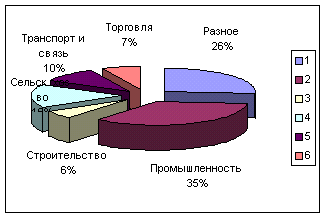
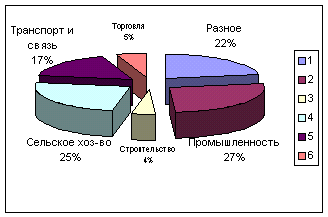
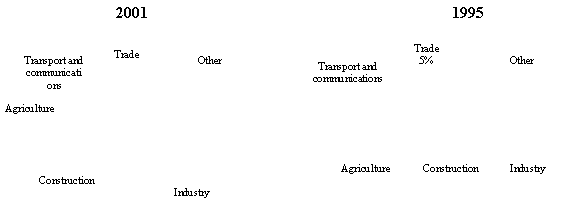
Figure 1 GDP structure, 2001 and 1995
Industry. Fuel, energy, oil and chemical sectors make the major input in the growth of the industry of the Republic. In 2001 about 15 million tons of oil, more than 6 billion m3 of gas and 18.2 billion kwt/hr of energy were produced in Azerbaijan. As for the car-building, food, textile and light industries, construction materials and other sectors, they are mainly non-operating or the production is reducing, though new high technologies are introduced.
Main reasons of this situation in industry are the loss of traditional markets for the industrial production, out-of-date equipment and, correspondingly, low quality and poor design of products which cannot compete the world analogues.
The dynamics of industrial production is given in Table.
Table 2.2.2.4 General economic indices of industry
|
Indices |
1990 |
1995 |
2000 |
|
Production flow, million manat |
1220 |
8 855 950 |
16 681 035 |
|
Number of enterprises |
3839 |
2984 |
4835 |
|
Number of employees, thousand |
409.1 |
304.3 |
193.2 |
|
Main production funds, prices of 2000, billion manat |
14348.0 |
21954.1 |
28614.9 |
|
Fund return |
3.07 |
0.83 |
0.51 |
Agriculture is especially important for the country's economy. During the last decade it has undergone a serious crisis, and only some production growth, particularly in animal husbandry followed the land reform (1997). All kolkhoz and sovkhoz systems were cancelled, 819,000 families received their own land plots. Nowadays 30% of the labour force of the Republic is engaged in the agricultural sector, and its share in GDP is about 20%. At the same time, the capacities of the agriculture both in terms of production and employment are not fully used yet.
Agricultural production dynamics is given in Table.
Table 2.2.2.5 General economic indices of agricultural production
|
Indices |
1990 |
1995 |
2000 |
|
Volume of manufactured production, million manat Including: |
506.7
|
3566914.1
|
5303389
|
|
Plant growing |
321.9
|
2090534.3
|
3086186.0
|
|
Cattle breeding |
184.8 |
1476379.8 |
2217203.0 |
For the nearest future the macroeconomic policy of the government will be focused on maintaining the achieved macroeconomic stability and balanced budgetary, monetary and credit policies.
In principle it means that the future economic policy is to involve the following four economic segments in the economic turnover:
Industry: self-sufficient in terms of fuel, energy, minerals-and-raw-material resources; product supply to the domestic market; increasing export capacity due to the export of not only crude oil but of the production of car-building industry, ferrous and non-ferrous metallurgy, petrochemical, chemical and light industries.
Transit capacity: annual increase due to the implementation of Silk Road project. It is expected that the volume of goods traffic via Azerbaijan will increase by 10-15 times
Agriculture: sufficient supply to local markets (food security)
Use of economic capacities of the districts and free labour resources by means of incentives provided by the development of tourism.
The growth of production in fuel and energy sector is supported by the large foreign investments. In accordance with the Oil Strategy of Azerbaijan Republic the development of oil and gas industry is determined by contracts, signed with the large oil companies of the world. According to SOCAR estimates, 18 million ton of oil and 11-12 billion m3 of gas will be produced in 2005, 60 million ton of oil and 20-22 billion m3 of gas - by 2010.
Having solved the task of further development of oil and gas industry as the defining field of economy, the Government of Azerbaijan intends to implement a special development program for the non-oil sector of economy and infrastructure, in order to upgrade it to international standards. The estimates show that within next 3-4 years Azerbaijan will not have sufficient finances to support this activity, therefore the development of non-oil sector will be sponsored by foreign investments. The most favourable economic conditions will be created for the investments.
Considering the location and the importance of Baku which can become a regional centre for the supply of financial, transport, oil and communication services to the Caspian markets, the government of Azerbaijan intends to remain a leader in transportation of hydrocarbons via the territory of Azerbaijan.
For the sustainable development of the field the government plans to develop and implement targeted programs focused on: massive improvement of land fund; establishment and development of agricultural infrastructure; creation of necessary conditions to attract credits to agriculture; support of market economy; formation of agricultural information and regional scientific services for introducing new technologies and ways of organisation of work, study of best international practices; sustainable power, water, telecommunications supply in the rural areas; development of handicraft; use of forestry resources; development of rural tourism; economic incentives for any investments into the rural areas. Agricultural Credit Fund was established to address these tasks. It will finance different projects in the agricultural sector. It was also decided to exempt agricultural sector of all taxes.
The government, in its middle-term program of economic development considers development of natural resources, in particular oil, additional investments, support of transition to the market economy. It shall be done by means of establishment of an institutional network, development of a private sector and adequate infrastructure.
Considering the above, the Caspian is especially important for the economic development of the Caspian. For Azerbaijan, the unique reserves of hydrocarbons and valuable fish species (sturgeon) of the Caspian are the most important resources. Besides, the sea is an important passenger and cargo route, the coastal areas are unique resorts and treatment places, attractive for both local and foreign visitors (development of tourism). At the same time, environmental situation of the Caspian is far from being satisfactory and requires urgent measures from the government. A long term program under the National Action Plan is a preferable option. It can be divided into a few stages, and they should address the most acute problems. The first stage should have a limited timescale (five years) to implement the priority actions to accumulate rapid positive impact on the Caspian environment and overall life style of the Republic. The actions should be low cost and highly effective.
The government realizes that the environmental protection of the Caspian sea is a long-term and costly process. However, the government has certain limitations that hinder the development of the environmental sector. These include, first of all, lack of finances, especially for long-term plans that require significant investments.
Planning and financing conducted by the government did not have sufficient analytical background, therefore the decision makers could not take appropriate decisions to increase the effectiveness of the work in this sector. Budgeting and financial management of the sector feature permanent lack of funds and low balance with the other sectors, which hinders allocation of necessary finances against the environmental sector. The NCAP will allow the government to prioritise environmental projects for the Caspian, develop an investment program for the next 5-10 years and correct the economic development plans.
The government conducted significant work to support national priorities and to address the investment requirements under NEAP. The priority investment fields are as follows: bioresources management, biodiversity protection, pollution control, integrated coastal zone management (including desertification). We would like to mention a Project of Instant Environmental Investments that includes construction of a fish hatchery with an annual release of 15 million of juvenile sturgeon, cleaning of ore contaminated soils, construction of a toxic waste disposal site, development of methods for cleaning of oil contaminated lands etc.
Caspian Sea is of high importance for the life of Azerbaijan people. Caspian is unique not only due to its physical and geographical parameters, but also due to its endemic flora and fauna, and enormous resources of hydrocarbons.
During 120-year history of oil production in the country 68 oil and gas fields were found, including 42 onshore and 26 offshore in the Azeri sector of the Caspian. 61 fields were operating, 40 of them onshore, 21 offshore. By the 1st January 2000 1360.6 million tons of oil, 27.4 million ton of condensed gas and 458.6 billion m3 of gas were extracted. The percentage of developed reserves is 87% onshore, offshore is 59%.
A role of offshore oil extraction became more significant during the last decades. Now the offshore oil and gas production is more than 90% of total. The figures given above show a high importance of oil sector in social and economic life of the country.
The Caspian is an important transport route. From the early days passengers and cargo transportations formed an essential part of the turnover of the coastal countries, and since the construction of Volga-Don shipping canal sea ports of the Caspian, especially Baku, received an access to the world oceans.
It is difficult to overestimate the role of the Caspian fisheries, especially sturgeon. As about 90% of the world sturgeon are located in the Caspian Sea, the region has traditionally been a main supplier of caviar and fish products to the world markets. For the population of coastal areas of the Caspian Sea, fishing was a main source of income and nutrition.
The location along meridian, peculiarities of coastal climate and geographical landscape create favourable conditions for recreation.
Actually the entire coastal part, including Yalama-Nizovaya area, northern and southern coast of Absheron peninsula and Lenkaran area up to Astara are recreation and sanatorium areas – spa treatment zone for local population and tourists.
Almost the entire territory of Azerbaijan (98.9%) is a part of the catchment area of Caspian Sea. Close location of environmentally hazardous industries and agriculture traditionally discharging concentrations exceeding MPC’s, environmental and geographic pressure of Armenia and Georgia resulted in growing anthropogenic impact on the nature which exceeded the maximum permissible levels. As a result, even after the collapse of the Soviet Union the environmental balance in the country seems to be severely disrupted.
The spatial parameters of the negative impact of the anthropogenic processes and the natural phenomena are quite various and spread all over the Republic.
Almost the entire area of Baku bay and 26.6 % of the coastal area are affected by a complex contamination, almost half of the rivers longer than 100 km are heavily contaminated. All the lowland lakes of the Republic are affected by the changes of thermal, biological and chemical regimes. The lakes of Absheron peninsula and Kura-Araz valley with total area 190 km2 are in critical condition.
51.8% of the territory is affected by erosion processes, out of which 14.0% is heavily eroded, 14.2% - medium, 23.6% is low. In some mountainous regions the erosion process affected 70-80% of territories. More than 40% of the arable areas are affected by erosion. The area of salt lands in the Republic is 1350 thousand hectares. Mineral fertilises and pesticides infected 12.1% of Azerbaijan territory. The contaminated and damaged area is about 30 thousand hectares.
The most severe and typical environmental forestry problems include: an extremely high (83.6%) proportion of territories with low forest cover; contamination of forests by industrial wastes; cattle grazing, and recreation activity. The most severe anthropogenic impact on forests includes the felling of trees for heating purposes; the degradation of forest berries, mushrooms, medicinal plants etc. And the fauna of Republic is directly affected by the changes in flora. With the decrease of habitats species distribution and abundance reduces. 37 species of flora and 64 species of fauna are considered to be rare and endangered.
Main sources of contamination of the environment include:
Water resources: industry, energy and heating, agriculture, utilities/domestic sector, recreation;
Air: transport, industry, utilities/domestic sector;
Soil: agriculture, industry, water management, city planning, transport, engineering infrastructure, recreation;
Fauna and flora: agriculture, industry, transport, recreation and engineering infrastructure.
In the complex environment protection scheme developed in 1989 problem situations were used to describe the type and level of anthropogenic impact over environment, in order to prepare the a strategy for environmental protection and to prioritise environmental activities.
Each problematic situation (377 in total) was connected to a certain source of unfavourable impact, with the following distribution by pollution types:
Development
of subsoil resources Water Air Mining Soils
Degradation
of vegetation cover Noise City
construction
This “historic heritage” was left to the country before it got its independence.
The Caspian impacts mainly the eastern part of the Republic including four economic-geographical districts. The total area of the districts is given below with the distribution of land fund by the categories of land use.
Table 3.2.1.6 Distribution of land fund (thousand hectares)
|
Economic-geographic districts |
Total area |
Agricultural lands |
Farmlands |
Forests |
Other |
|||
|
Total |
Arable lands |
Perennial herbs |
Pastures, hayfields, fallow lands |
|||||
|
Guba-Khachmaz |
696.5 |
420.9 |
33.7 |
119.3 |
267.9 |
13.4 |
119.8 |
142.4 |
|
Apsheron |
664.0 |
289.1 |
5.9 |
61.4 |
221.8 |
12.8 |
11.4 |
350.7 |
|
Central Aran |
873.7 |
456.4 |
0.2 |
254.8 |
201.4 |
25.6 |
4.7 |
387.0 |
|
Lenkoran |
606.9 |
277.7 |
18.1 |
106.9 |
152.7 |
16.0 |
148.0 |
165.2 |
|
Total |
2841.1 |
1444.1 |
57.9 |
542.4 |
843.8 |
67.8 |
283.9 |
1045.3 |
The coastal zone is the most populated territory of Azerbaijan Republic, where the density of population is more than twice as high as in other areas. Three large cities are located in the zone, and the proportion of urbanized population is 81%. Apsheron and Lenkoran areas are highly populated, unlike Central-Aransky district (table 3.2.2.7). It is necessary to note that due to similar economic problems the demographic rates (natural growth, birth rate, mortality, life expectancy etc.) do not vary a lot between the areas.
|
Administrative units |
Area, km2 |
Population in 2000 |
Density, people/km2 |
Natural growth, % |
Urbanization, % |
|
Khachmaz |
1050 |
147.0 |
140 |
1.01 |
35 |
|
Divichi |
1090 |
46.8 |
43 |
1.01 |
72 |
|
Siazan |
700 |
34.2 |
49 |
1.01 |
66 |
|
Khyzy |
1850 |
13.4 |
7 |
1.04 |
47 |
|
Sumgait |
80 |
286.9 |
3586 |
1.03 |
100 |
|
Baku |
2130 |
1807.3 |
848 |
1.02 |
100 |
|
Apsheron |
1360 |
84.3 |
62 |
1.01 |
44 |
|
Ali-Bayrmali |
30 |
70.5 |
2350 |
1.00 |
100 |
|
Salyan |
1790 |
114.1 |
64 |
1.02 |
35 |
|
Neftechala |
1450 |
72.8 |
50 |
1.02 |
45 |
|
Masalli |
790 |
177.2 |
224 |
1.01 |
82 |
|
Lenkoran |
1540 |
192.5 |
125 |
1.00 |
41 |
|
Astara |
620 |
86.4 |
139 |
1.01 |
22 |
|
Coastal zone |
14480 |
3133.4 |
216 |
1.01 |
81 |
|
Republic |
86600 |
8081.0 |
93 |
1.01 |
51 |
The coastal area of Caspian is the most populated territory of Azerbaijan Republic. According to the last population census (2000) there are 3133.4 thousand people (apart from refugees, IDPs and seasonal migrants) live here, which is 38.7% of total population; 69.1,8% of population lives in three cities: Baku, Sumgait, Ali-Bayramly. Population density of coastal zone exceeds 120.4 people/km2. More than 31% of population are children below 14 years, 65.5% of population is below 35, 8,4% of population is above 60. The coastal area is famous for its long-livers. 0,6% of the population is above 80, 457 people are 100 years old or older. Ethnicity wise, over 85% are Azerbaijani, the rest are Russians, Lezgins, Talish, Jews, Ukranians, Tatars and others.
Family life is stable; a number of divorces, especially at the rural areas, is low - about 0.5-1.0 divorces per 1000 people. In more than 60% of rural families there are 3 or more children.
Employment of population. In spite of the large human resources (above 50% of the total coastal population), their participation in labour activity varies in different zones as follows: 50-75% in Guba-Khachmaz, 58-59% in Baku and Sumgait and 15-74% in rural parts of Absheron, 42-95% - in Central Aran, 16-88% - in Lenkaran. Generally the employment in the coastal area in 1999 was 59%. People are mainly engaged in industry, agriculture, construction, logistics etc. In non-productive fields, such as education, culture, art, science, health care, social security, housing-utilities sector, service, physical culture, transport and communication, management, crediting and insurance, employment is from 11-12% up to 45-47% (in different regions). The exceptions are cities like Baku, Sumgait and Ali-Bayramli, where the employment in non-productive sector is dominating – up to 62-68% of employed population; this is explained by crisis in the main industries, located in these cities.
A developed infrastructure of medical institutions, including treatment-preventive, sanitary-hygienic and pharmaceutical institutions exists in the coastal area. In Baku and Sumgait the largest medical institutions are located, and also hospitals, dispensaries, polyclinics, and medical cabinets. Some institutions (railways, sea transport, defence, police, and state security) have an internal system of medical care. In some regional centres medium and small medical institutions are functioning, and in villages there are out-patient clinics and doctor’s assistant cabinets.
While examining average chronological (for 10 years) intensive rates one can see that the lowest sickness rate in the coastal area is among the adolescents and adults in Absheron peninsula and central Aran (lowland) districts, and also among children in Guba-Khachmas and Central Aran districts.
The republican statistic data for 1999 shows that respiratory deceases, nervous and blood deceases, and cancer have respectively the highest rates of occurrence per 100,000 people (Figure 4).
Transmissible
and parasite deceases Cancer Endocrine Blood
deceases Mental
deceases Nervous
deceases Respiratory
deceases
As it is clear from the Figure 7, respiratory deceases make 60% from total, 28% - nervous and mental deceases, blood deceases and cancer.
Among all nosology deceases (in comparison with the total Republic rates) the most spread ones are respiratory diseases, traumas and poisoning, anomalies by birth (Central Aran) and blood circulation system diseases (Absheron). The highest number of worm deceases, typhoid, acute polio is in Lenkaran zone.
3.2.4. Education
The population of the coastal area is completely literate. The primary and secondary schools are available in all settlements, secondary special and high educational institutions are in Baku, Sumgait, Ali-Bayramly and in the majority of administrative regions’ centres. In 1999 the total number of students in the coastal area was 970,000, out of them 855.5 thousand was primary and secondary education students, 21.2 thousand was for specialised secondary education and 93.3 thousand was high education students.
3.2.5 Culture and Sport
The population of the coastal area has an opportunity to satisfy its cultural and aesthetic requirements. There is a network of sport facilities and cultural-education institutions. In cities and settlements of the area there are cinemas, stationed and mobile cinema facilities, theatres, museums, clubs and public libraries. The cities and the regional centres have summer and winter sporting complexes for athletics, swimming, sea and game types of sport.
3.2.6 Economy
Economy of the coastal zone is characterised by highly developed diversified industry and agriculture. The following industries are dominating: fuel and energy, machinery, metallurgy and chemical complexes, construction materials production, and also light and food industries. The agriculture is specialised on the production of cereals, cotton, vegetables, fruits, cattle breeding and paltry. Before 1990 the economy of the region was permanently (annually) growing, with the rates of growth from 2 to 15% at different years. A peak of development the economy of the coastal area reached in 1985-1989.
Collapse of the USSR and destruction of traditional inter-Republic, interagency and inter-production relationships, loss of goods exchange and markets resulted in deep economic crisis and severe reduction of Gross Domestic Product (GDP) and other social economic indices. A significant damage to the coastal area was caused also by the Caspian Sea level raising. Since 1996, when the economy was restructured, the rates are stably and successfully growing. More detailed economic-social characteristic is given below.
Guba-Khachmaz zone. The basis of economic potential of Guba-Khachmaz zone is agro-industrial complex. In the structure of agriculture a leading role belongs to vegetable-growing, fruit-growing, viticulture, cereals growing, cattle breeding and paltry. Food industry is dominating including fruit processing and fish processing plants, cereals combines, vine and dairy plants. In the coastal settlement the fishing communities are functioning. Light industry is represented by carpet factories and small sewing enterprises. Heavy industry includes oil and gas production (4% of the total onshore output), and also there is a plant of electro-technical production.
Absheron zone is the most developed, from economic and social aspects, region of Azerbaijan, which produces 60-62% of GDP. The following industries are dominating: fuel and energy complex, chemical and petrochemical industries, machinery and metallurgy, etc. Mainly all large enterprises of the above mentioned fields are located in Baku and Sumgait.
In agricultural structure a main emphasis is given to suburban meat and milk enterprises, vegetable and vine growing all over the Absheron peninsula. In rural areas (Absheron and Khyzy administrative regions) cereals growing, animal husbandry, paltry, partially sheep-breeding and viticulture prevail.
This area is the biggest transport area of the Republic. Here the biggest educational, cultural and sport institutions are located.
Central Aran (Low Kura) zone. The economy of this district is focused on fuel-energy complex and some other fields of industry, but in general it is an agricultural zone.
Oil and gas industry is represented by 4 oil-and-gas development enterprises, which produce 35-40% of total onshore output. Exploration drilling now commenced offshore.. In the low Kura and its delta there are developed fisheries, there are fish processing plant and two fish hatcheries there.
In agriculture cereal growing, cotton and animal husbandry dominate.
Lenkoran zone. The basis of economic potential is the agro-industrial complex, specialised in growing and processing of herbs. The following fields of agriculture prevail: plant and tea growing, viticulture, cereal growing (including rice) and citrus plants. The region produces 100 % of tealeaves in the Republic, citrus plants, rice. The dominating food industry includes tea factories, fruits and vegetables plants, fish processing and fish cannery plant,s meat and milk processing plants. Fishery is also developed on the coast.
Offshore exploration drilling is conducted in Lenkaran, Lenkaran-Talish, Inam, Kur-Dashi Contract Areas. The diversity of the natural – climatic resources (subtropical climate, seaside beaches, foothills and mountainous forests, mineral and thermal springs), and historical – ethnographic monuments create favourable conditions for tourism and sanatorium treatment of the population.
3.2.7 Economic damage of the sea level rise
Due to the sea level raise a part of the coastal area was flooded and the abrasive processes were activated along the entire coastline. The damage caused by flooding is 1078 billion manats (agriculture- 684.2 billion manats, constructions and houses - 394.6 billion manats, prices of 1996).
Fixed sources. The air of Apsheron peninsular is the most polluted due to the emissions of fuel-energy, oil and chemistry, metal industries, car building complex, m the industry of construction materials. Fuel-energy complex has a negative impact on Ali-Bayramli, too. In other inhabited areas fixed pollution sources include boilers and local heating systems of light and food industry. However, due to low production and energy crisis during the last decade air pollution from fixed sources reduced as shown in the tables.
Table 3.2.8.1.8 Dynamics of air emissions
|
Economic-geographic districts |
1990 |
1999 |
||
|
Amount of fixed sources |
Total emissions (thousand tons) |
Amount of fixed sources |
Total emissions (thousand tons) |
|
|
1. Guba-Khachmaz |
98 |
26.6 |
53 |
1.17 |
|
2.Apsheron |
10467 |
1503.1 |
7552 |
367.33 |
|
Including Baku |
9227 |
1395.9 |
6494 |
326.65 |
|
Sumgait |
1158 |
96.5 |
978 |
40.3 |
|
3. Central Aran |
1122 |
106.9 |
871 |
82.93 |
|
Including Ali Bayramli |
380 |
67.3 |
249 |
31.7 |
|
Lenkoran |
163 |
26.3 |
40 |
0.06 |
|
Total in the coastal area |
11850 |
1663.5 |
8516 |
451.49 |
Transport. Although emission from fixed sources decreased due to the reduced production, traffic emission significantly increased and in 1999 reached 47%, compared with 26% in 1990. The share of the coastal zone in total emissions increased from 35-40% in 1990 o 60-65% in 1999. In three cities (Baku, Sumgait and Ali-Bayramli) total emission was estimated as 197.2 thousand ton, the calculations were based on the traffic load in the coastal zone and annual use of fuel. This includes 138.5 thousand ton of carbon oxides, 37.3 thousand ton of hydrocarbon, 7.8 thousand ton of nitric oxide. 191.5 thousand ton were discharged in Baku, 4.4 thousand ton in Sumgait, 1.3 thousand ton in Ali-Bairamli.
Table 3.2.8.1.9 Dynamics for air emissions discharged from fixed sources (thousand ton)
|
Economic-geographic districts |
Years |
Total emissions |
including |
||||||
|
Solid substances |
Gas and liquid |
|
|||||||
|
SO2 |
CO |
NO |
CH |
VOC |
|||||
|
Guba-Khachmaz |
1990 |
26.6 |
- |
26.6 |
0.6 |
0.5 |
0,2 |
25,3 |
- |
|
1999 |
1.17 |
0.05 |
1.12 |
- |
0.07 |
0,02 |
1,02 |
0,01 |
|
|
Apsheron |
1990 |
1503.7 |
123.1 |
1380.6 |
29.6 |
57.3 |
24,9 |
1236,0 |
24,2 |
|
1999 |
367.33 |
12.68 |
354.65 |
7.07 |
20.1 |
10,42 |
307,36 |
9,2 |
|
|
Including Baku |
1990 |
1395.9 |
103.6 |
1292.3 |
16.6 |
45.9 |
14,0 |
1195,9 |
16,0 |
|
1999 |
326.6 |
10.7 |
315.9 |
3.9 |
17.5 |
8,1 |
279,4 |
6,6 |
|
|
Sumgait |
1990 |
96.5 |
8.6 |
87.9 |
13.0 |
11.0 |
10,9 |
40,1 |
8,2 |
|
1999 |
40.3 |
1.7 |
38.6 |
3.1 |
2.6 |
2,3 |
27,9 |
2,6 |
|
|
Central Aran |
1990 |
106.8 |
0.6 |
106.2 |
25.6 |
1.6 |
16,3 |
62,0 |
0,7 |
|
1999 |
82.93 |
0.62 |
82.31 |
8.4 |
0.31 |
8,82 |
63,58 |
1,1 |
|
|
Including Ali-Bayramli |
1990 |
94.4 |
0.3 |
94.1 |
25.5 |
1.0 |
16,2 |
50,7 |
0,7 |
|
1999 |
31.7 |
0.4 |
31.3 |
8.4 |
0.1 |
8,7 |
13,2 |
0,8 |
|
|
Lenkoran |
1990 |
26.3 |
0.5 |
25.8 |
- |
1.0 |
0,1 |
18,5 |
6,2 |
|
1999 |
0.06 |
0.04 |
0.02 |
0.01 |
0.01 |
- |
- |
- |
|
|
Total emissions in the coastal area |
1990 |
1663.4 |
124.2 |
1539.2 |
55.8 |
60.4 |
41,5 |
1341,8 |
31,1 |
|
1999 |
451.49 |
13.39 |
438.1 |
15.48 |
20.4 |
19,26 |
3 71,9 |
10,31 |
|
Atmospheric fall-outs of chemicals are registered and estimated by National Hydrometeorological Service of MENR that conducts environmental monitoring at hydromet stations in Khachmas, Pirallahi island (Apsheron), Neftechala and Lenkoran. The results of monitoring for 1999 are provided in the table below.
Table 3.2.8.1.10 Average density (a.d.)-t/km2 and weight (w)-thousand ton of atmospheric fall-outs
|
Economic-geographic districts |
Total emissions |
Sulphate sulphur |
Nitrate nitrogen |
Ammonia nitrogen |
Chlorine |
Hydrocarbons |
|||||
|
a.d. |
w |
a.d. |
w |
a.d. |
w |
a.d. |
w |
a.d. |
w |
||
|
1. Guba-Khachmaz |
84,3 |
5,6 |
39,0 |
2,0 |
13,9 |
0,2 |
1,4 |
1,3 |
9,1 |
3,0 |
20,9 |
|
2.Apsheron |
238,1 |
12,1 |
80,3 |
2,4 |
15,9 |
0,07 |
0,5 |
13,3 |
88,3 |
8,0 |
53,1 |
|
3. Central Aran |
179,0 |
6,5 |
56,8 |
1,9 |
16,6 |
0,3 |
2,6 |
7,8 |
68,1 |
4,0 |
34,9 |
|
Lenkoran |
116,0 |
7,3 |
44,3 |
4,4 |
26,7 |
0,8 |
4,9 |
5,5 |
33,4 |
1,1 |
6,7 |
|
Total in the coastal area |
617,4 |
|
220,4 |
|
73,1 |
|
9,4 |
|
199, |
|
115,6 |
The proportion air emissions in the districts is shown on the diagram.
Guba-Khachmaz Lenkoran
Central Aran Apsheron
During the last decade negative environmental impact reduced due to the economic crisis. In 2000 918 thousand ton of pollutants were discharged (51.7% of total in 1988). Industrial discharges reduced by a factor of few times, use of mineral fertilizers and pesticides reduced by a factor of ten. Impact on forests and soils reduced a lot too. Poor supply of power and gas resulted in massive use of firewood, and felling, subsequently. The area and thickness of forests reduced, regime of natural rehabilitation of biocenosis was changed, cattle was over-grazing. This speeded desertification processes (degradation of forests and soils, changes of water balance and strengthening of processes of water and wind erosion).
At present pollution of soils varies a lot, from clean soils (no human impact), to medium and strong pollution. The main sources of soils pollution include the residue of mineral fertilizers and pesticides in agricultural areas and industrial wastes in cities.
In cotton growing areas of Central Aran average level of pesticides (DDT, DDE, phasanol, treflan etc.) in the middle 90’s was 8-10 MPC, with localised concentrations of 50-60 MPC. Winter pastures of the area are medium contaminated (0.4-1.1 MPC).
In the soils of Samur-Divichi, Prikaspiski-Apsheron, Gobustan and Lenkoran areas maximum concentrations of pesticides (with average level of 1-10 MPC) included 20-28 MPC in vegetable plantations, 20-25 MPC in wheat fields, 20-42 MPC in fruit gardens, 20-50 MPC in vineyards. Survey of soils in cotton fields and vineyards showed that total DDT in forage crops, wheat, potatoes, beans, onions, corn were 3-12 MPC, i.e. residual concentration of pesticides in agricultural product is 13-15% of their total one.
High concentrations of nitrates were found locally in the arable lands and farmland of Apsheron peninsular and other districts where mineral and organic fertilizers were used. Sand and super sand soils are the most polluted with nitrates. A strong nitrate contamination is found in hotbeds growing flowers and vegetables.
The coast of the Middle Caspian from the Samur river to the Apsheron penisular is the cleanest. Only the concentration of strontium are above the permitted level due to natural reasons: new Holocene sediments rich with strontium.
17 main pollutants were found in the soils of Apsheron peninsular (Cu, Sr, Mo, Cr, Ni, Co, Zr, Ti, Yb, B, Ba, V, W, Pb, Sn, Ga and Ag), 34 pollutants were found in Baku (Zn, Bi, Mn, La, F, Ce, Li, Y, Hg, Cd, Hf, As, Sb, P, in addition to the above listed). Zn, Mn, Cu, Cr, B, Mo, Sn, F, Hg, Sr are the most typical for Sumgait. The special surveys conducted in Baku and Sumgait revealed 7 and 6 toxic disposal sites where total concentrations of pollutants exceed the baseline ones by a factor of 3-20 to 150-300, in some areas – by a factor of 600-800. A situation in Sumgait Chlorine Alkaline factory is catastrophic, as over 80 of mercury concentrated in soils at the depth up to 6 m due to historical leaks, obsolete technologies and poor storage of muds.
In the residential areas of Baku and Sumgait where technical impact is low transport makes the highest input in pollution; the pollution is more dangerous as lead and zink accumulate in soils.
50-55% of the cities and 37% of Apsheron peninsular are medium or heavily contaminated.
Surveys were conducted on the coast of the South Caspian in the Kura delta and Lenkoran lowlands.
In the first case 23 pollutants were identified. 6 elements are the most common P, Pb, Cu, B, Mn, Zn) and are found on 25-32% of the survey area with concentrations of 1.5-10 MPC. Other pollutants (Sr, La, Zr, Cr, Ni, Bi, Ba, Ti, Sn, Nb, Y, V, Mo, Ag, W etc.) are found in localised concentrations of 3-10 MPC.
Ag, Sn, Sr, Be, Cr, P (1.5-11 MPC) were the most common pollutants in Lenkoran, Zn, Pb, Ni, Ba, Li, Yb, Y, Mn, B, Ti, Nb, V encountered in localized concentrations.
Oily and produced waters, oil spills, oil products and wastes are significant sources of pollution in oil fields of north-east foothills of the Great Caucasus (Siazan monocline), Apsheron penisular, Gobustan, South-East Shirvan. Average content of oil and oil products at the depth up to 5 cm exceeds baseline levels by a factor of 10-60, in some places by a factor of 100. In Apsheron total area contaminated with oil exceeds 10 thousand hectares. 18-20 thousand hectares of contaminated territories are located in the coastal areas.
Soils are contaminated with benzopirene around Baku and Sumgait and with toxic polychlorinated biphenyl on the territory of electrical industries.
One of the main factors that complicate radio environmental situation is oil and gas development. Development of oil fields resulted in accumulation of radionucleids. Their concentrations in some areas are so high that the soils must be buried as radioactive wastes. Oil and produced water contain radium, thorium and radioactive potassium that penetrate into soils, settle on the walls of the pipelines, accumulate in treatment facilities and service facilities of oil fields. There the level of radiation exceeds the baseline concentrations by a factor of 50-150 (500-600 microrentgen per hour). Exceeding concentrations of radionucleids are also found in the wastes of oil, chemical and iodine-brome industries. The problem is that many of the former industrial sites are now used as residential areas, and houses are built even next to oil wells. In such buildings an extremely high level of radon gas is found, as it extracts from the soils contaminated with radium-226.
Special surveys of Great Baku in 1988 found 157 sites of localized and large scale pollution with radionucleids, where radiation varies from 120 to 3000 mkr/h. On 31 sites were cleaned, mainly in the central part of the city.
Rivers. Most of the rivers of the coastal area are polluted, mainly the Kura that transports industrial and domestic sewage from Georgia, Armenia and West Azerbaijan. The Kura transports 520-530 million m3 of sewage, 500 million m3 come from Georgia and Armenia. About 5 million ton of chemical pollutants and above 40 million ton of detritus are discharged to the Caspian. In the middle and low Kura water is polluted with phenol, oil products, heavy metals, ammonia nitrogen, and the concentrations are 5-15 MPC. Besides, discharge of untreated sewage increases BOD.
23 pollutants were identified in the low Kura. 13 of them are the most common and are found in 20-42% of sediments (W, Sr, Nb, P, Zn, Ag, Cu, Co, Sn, Sf, Pb, V, Y, B, with concentration of 1.4-15 MPC). Bi, Mo, Cr, Li, Mn were found in concentrations of 1.2-8 MPC.
The quality of water varies from clean to medium contaminated in the middle and low rivers. The main sources of pollution include domestic and industrial discharges of residential areas and industries, as well as the wash out of mineral fertilizers and pesticides from the agricultural soils. The impact on river water quality can be divided into areas with MPC concentrations (foothills and northern slope of the mountains, south-eastern lowlands of the Great Caucasus and mountainous part of Talysh), areas with some concentrations exceeding MPC (Shollar plain, Divichi-Sumgait coastal zone, north-east Gobustan, Lenkoran lowland), and areas with several concentrations exceeding MPC (South-East, Central and Western Gobustan, Central Aran).
Internal water bodies. Pollution of lakes and water reservoirs of the coastal area occurs due to river discharge and sources of pollution located on the coast. In rural areas it is mainly industrial and domestic discharges, minerals and pesticides.
Water bodies of Apsheron suffer from industrial and domestic pollution. The relic lakes (Beukshor, Ganligel, Bul-Bul, Masazir, Mirzaaladi etc.) are polluted with oil and oil products (1.5-14 MPC), phenols (3-32 MPC), detergents (up to 2 MPC), surfactants (3-4 MPC). Biochemical changes feature high concnentrations of ammonia nitrogen (2-4 MPC), nitrites (2-5 MPC), phosphates (1.5-5 MPC), ammonia (1.5-7 MPC). Oxygen content in the lakes also is not satisfactory.
Important sources of pollution include oily and produced waters, sewage of oil processing and gas processing factories that concentrate in many ponds and reservoirs. Thus, seage of OTF after A.Amirov transport over 50 ton of oil products, 300 ton of suspended particles, 6 ton of surfactants, 52 ton of hydrogen sulphide, 1 ton of sulphates, 2.5 ton of chlorides, 1 ton of phenol. Sewage of oil treatment facilities contain 2200 tons of oil products, 1100 ton of suspended particles, 60 ton of surfactants, 27 ton of hydrogen sulphide, 76 ton of phenol, 2 ton of manganese. The compounds accumulate in water bodies and are found in aeration zone and first level of ground waters.
the most negative element of geo-environmental situation is human induced swamping and flooding, mainly in Apsheron peninsular.
Swamping is different from flooding, as it is not connected with ground waters, while flooding results from increase of water table and is an element of a common hydrodynamic system. Anthropogenic swamping is mainly found in the Central Apsheron, in the irrigated areas. The largest swamps are located in the external part of Baku trough which is a range of plains with slight slopes. The main human impact here includes discharges of oil industry.
Water table of Apsheron peninsular is formed under anthropogenic impact which includes water intake or infiltration of surface technical waters. This changes ground water depth, with various periods of rises and falls. In the most part of the peninsular water table rises except for the small area in the north-east where the level of ground waters does not change or lowered by 1-2 m due to intensive water intake.
The central part of the penisular from Kurdakhani in north-west to Govsani in south-east is flooded or is under the threat of flooding. The flooding originates from oil discharge and Apsheron Main Pipeline (AMP). Regulation wells drilled in the 50-s show gradual increase of ground waters before commissioning of AMP due to oil industry discharge. In 1959-1960 in north-west and in 1964-1966 in south-east of the area the water table started raising (after commissioning of AMP and introduction of irrigated agriculture). The level rose for 10.0-15.0 m from 1962 to 1998. The water table is still rising.
The second important flooded area is in the north of Jeyranbatan water reservoir. The area formed due to Samur-Apsheron canal and industrial discharges of Sumgait extends from the north of the reservoir to Sumgait. A lot of areas of the city are flooded by leaks from water pipelines. The results of the chemical analysis of water samples taken from flooded basements and water and sewage pipelines showed that their content was identical.
Since 1996 the sea retreats and bares areas that were flooded during transgression in 1976-1995.
The ground waters are mainly polluted with industrial wastes and discharges, domestic sewage; in rural areas pollutants include wastes of animal breeding and poultry farming, and partially the residue of fertilizers (minerals and pesticides) that penetrate into the soils through aquifers.
The ground waters of Apsheron peninsular are the most polluted. Thus, the ground waters in the area of Baku Iodine Bromine Plant and in the infiltration zones of oil treatment plants (drains) have high content of chlorine (11-50 g/l), iodine (0.005-0.029 g/l), bromine (0.005-0.28 g/l). Leaks from oil pipelines form floating oil slicks; their thickness varies from a few millimeters to 0.7-1.8 m. Infiltration from damaged sewage drains and facilities of Baku, Sumgait and other cities and towns result in chemical and biological contamination of ground waters. Nitrate and ammonium nitrates are the main pollutants. Another origin of the pollutants is a cultural layer. The composition of pollutants depends on the age of the buildings, density and condition of sewage network.
The Caspian Sea lies between 4713’ and 3634’ 35” north latitude and between 4638’ 39’’ and 5444’ 19’’ east longitude. The length of the Caspian (north-south) is approximately 1,200 km. The greatest breadth of the Caspian from east to west is 466 km; in the region of the Absheron peninsula, its breadth is only 204 km. The average breadth of the Caspian from the west to the east is 330 km. The surface of the Caspian is about 436,000 km2, and its volume is about 78,000 km3. The maximum depth of the Caspian is 1,025 m, and the average depth is 184 m.
This sea is commonly divided into three portions: the northern, middle and southern parts: the North Caspian (80,000 кm2), the Middle Caspian (138,000 кm2) and the South Caspian (168,400 кm2.). The Azerbaijan sector is located in the northern and southern parts of sea; it occupies 20.7 % of the total area.
The coastline from the Samur river to Kilazy cape is a narrow lowland strip that extends along the Great Caucasus; its width varies from 2.5 to 15 km. Between the Samur and Nizovaya settlement the coast is covered by forest with some dunes. Further to the south the coast features steppes and 5-6m high dunes. From Kilazy cape to Sumgait the coast is low, with small sand mounds along it. The northern coast of Apsheron is low, the highest points are near the Absheron lighthouse. The coast can get rather steep. The islands of Absheron archipelago (Pirallakhi, Zhiloy and others) lie to the east from Shakhova Kosa. A valley between Gousan cape to Shykh cape is quite hilly in places; here the Baku bay is located. From Shykh cape to Bandovan cape the coast is a low 3 km wide strip with poor vegetation. The strip is bordered by high hills (up to 400 m) from the east. Further to the south the coast is mostly low. Lenkaran lowland located south from the bay is 9-10 km wide; in the west it borders with the Talish Mountains. This is a humid subtropical area of Azerbaijan with the typical flora.
One of the most important features of the Caspian is its changing water level, a factor that has a significant effect on biodiversity and coastal management in the extensive shallow areas. The reasons of sea level change are mainly natural. At present the Caspian Sea level stands around the -27 m mark. The fluctuations occur within 2-3 m, but this is enough to affect an area of thousands square kilometres and to damage the environment. Local causes of increased or unnecessary environmental damage resulting from sea level change are: inadequate understanding of the processes causing natural changes in climate and thus changes in sea level; inadequate planning of coastal developments, resulting in unnecessary damage; reduced capabilities in meteorological, and hydrological monitoring, resulting in poor prediction of long- and short-term (surges and retreats) sea level changes.
Currents in the Caspian are primarily wind-generated. Along the western coast of the Middle Caspian, the prevailing currents are southeast and south. Current speeds average 20-40 cm/s with a maximum of 50 to 80 cm/s.
The middle and southern parts of the sea have only small fluctuations of salinity; surface salinity is about 12.6 to 13.5 ppt, increasing from north to south and from west to east. There is also a slight increase in salinity with depth (0.1 to 0.2 ppt) observed in all regions of the sea. Water temperature varies considerably with seasons from 13.6 to 29.00C (A.Kasymov 1991). As the salinity is similar and the temperature varies a lot, water density depends on temperature: autumn-winter cooling increases water density on the surface and results in vertical circulation; spring-summer warming decreases the temperature of suface water and prevents mixing of upper layers. During these seasons, convection occurs only at significant depths.
The content of oxygen and nutrients depends on vertical circulation of water. The highest oxygen content is found in winter, the lowest – in summer. Vertical circulation of water transports nutrients from deep layers to the surface ones for the development of phyto- and zooplankton, the fish food.
Evaporation from the sea surface differs between 700 mm/year to maximum 1400 mm/year, and it represents one of the principal outflow components.
The climatic conditions of the region are determined by the influence of cold Arctic air, moist sea air masses forming over the Atlantic Ocean, dry continental air masses from Kazakhstan, and warm air masses coming from the Mediterranean Sea and Iran.
Precipitation that determines river flow in the Caspian depends on climatic processes in Eurasia. Reduction of natural humidity and significant increase of water intake caused reduction of sea level since the 30-s till 1976. Sea level fall together with increased pollution with industrial wastes resulted in drying of spawning ground of semi-anadroumous fish in the river deltas, poor quality of food base and low fish reproduction level. Sea level rise that continued till 1996 did not reduce the pressure as it resulted in silting of river deltas.
Geology of the Caspian features multiple heights and depressions, deep fractures that form a complex of angular systems. A typical for the most part of the Azeri sector stratigraphic section contains sedimentation formed with various types of argillite. Argillite is interlaid with alverolyte and sand stone with high content of quartz. Beneath lay the strata with possible content of oil (productive strata formed with sediments of the Upper Miocene – late Pliocene); in deeper places argillite becomes more silty and sandy, then sandstone is found.
Azerbaijan is a region with high seismic activity, particularity in the mountainous areas. Five earthquakes above 6 Richter scale were registered here since 1842. The last earthquake occurred on 25 November 2000; it was 6.5 Richter scale with an epicentre located offshore at 30 km to east-north-east from Baku.
There are about 300 mud volcanoes in Azerbaijan which is almost half of all existing mud volcanoes. According to the estimates, 170 mud volcano complexes are found all over the Caspian, most of them in the Azeri sector, especially in the South Caspian.
Mud volcanoes can be island and underwater ones. Island volcanoes extend above the water surface and are exposed to weather conditions. Nine volcanic islands are located in the coastal waters (Khara-Zyrya, Zenbil, Sangi-Mugan, Garasu etc.).
In addition to the basic mud, eruptions contain debris, water, gas, oil which forms sediments with composition different from typical seabed. Eruptions can result in movement of sediments even on low slopes, and underwater currents can transport the mud to large distances.
Mud volcanoes are an important part of geological composition and geomorphology of the seabed but they complicate exploration, development and transportation of hydrocarbons.
Water quality in the Azeri sector of the Caspian is controlled at 54 stations of the National Hydromet Service of the Ministry of Ecology and Natural Resources. A complex environmental assessment of microbiological and hydrochemical parameters shows that the waters of the Middle Caspian from the Russian border to Sumgait are contaminated; waters of the South Caspian from Apsheron peninsular to Lenkoran are polluted; waters of Baku bay and Sumgait coastal waters are polluted and highly polluted. Biological analysis of 18 stations in Azeri sector of the Caspian showed that the concentrations of bacteria are the highest in Baku bay (1-3 million per 1 ml of water). In the rest of the Azeri sector the amount of bacteria varies from 100,000 to 500,000 in 1 ml.
Due to the pollution of water, diversity of benthic fauna reduced by a factor of 3 to 10. In Sumgait and Baku bay the diversity of Crustacea and of some mollusks significantly reduced.
The main sources of pollution in the Caspian include: river flow, oil and gas production, transportation of hydrocarbons, discharge of untreated industrial wastes, drainage of rural areas and domestic sewage.
Due to the collapse of the USSR a lot of industrial facilities ceased their operation, which reduced discharge of wastes and slightly improved environmental situation in the Caspian.
According to the water control organizations, 169.11 million m3 of polluted and 240.49 million m3 of relatively treated sewage were discharged in the coastal areas of the Caspian in 1999. The most of it was discharged in Apsheron district (Baku and Sumgait), 159.73 and 237.11 million m3 respectively.
Every year Azerbaijan discharges in the Caspian up to 4 thousand tons of oil and oil products, 500,000 tons of dry residue, above 70,000 ton of sulphates, above 300,000 ton of chlorides, about 500 ton of nutrients, up to 30 ton of phenol, mineral acids, diluted iron, nitrates, phosphates, pesticides etc.
95% of pollution still refers to oil products. Waters of Sumgait feature high level of hydrocarbons (2-10 MPC), phenols (7-12 MPC), detergents and nitrites (1-2 MPC). Water quality of the area can be described as polluted to very polluted.
In the coastal waters of North Apsheron (east from Sumgait) content of hydrocarbons exceeds MPC by a factor of 2-10, content of phenols is 8-10 MPC, other pollutants vary from 0.5 to 1 MPC.
Baku bay is the most polluted area of the Caspian. In 1999 155 million m3 of polluted and 210 million m3 of relatively treated waste waters were discharged in the bay. Content of hydrocarbons in the bay is 10-50 MPC, phenols – 18-30 MPC, mercury and detergents – 2-5 MPC. Besides, the concentrations of phosphates (12-15 mcg/l), nitrates (2-3 mcg/l), ammonia nitrogen (25-60 mcg/l) are 40-50% higher than in the other parts of the Caspian. Water quality of Baku bay is classified as polluted and very polluted.
The area of Oily Rocks is polluted mainly with oil products that are transported south and south-east by winds and currents. Concentrations of dissolved oxygen vary from 6 to 12 mg/l, hydrocarbons from 0.06 to1.25 mg/l as dynamic processes have a certain impact on their distribution. Content of phenols exceeds MPC by a factor of 5-20. Other parameters do not exceed MPC. The waters of Oily Rocks are classified as polluted.
In the coastal waters at the Kura delta vary from 0.07 to 1.8 mg/l, this exceeds MPC by a factor of 1-36. Content of phenols is 10 MPC. Water quality varies from contaminated to very polluted.
At Lenkoran coast the content of hydrocarbons varies from 0.05 to 1.40 mg/l (28 MPC), concentrations of phenols exceed the sanitary norm by a factor of 4-10 (0.04-0.1 mg/l). Water quality varies from contaminated to polluted.
In the Azeri sector of the Middle and South Caspian concentrations of heavy metals, dispersants, pesticides and nutrients in water do not exceed the norms, except for the Sumgait and Baku bay.
Human pressure on the ecosystem of the sea has the following impact: bioproductivity increases, species diversity of communities changes, trohpic links break, physical and chemical characteristics of water change. However, the process of anthropogenic eutrophication of the Caspian is not balanced. Thus, localized eutrophication was found along the coast of the Middle and South Caspian but by the early 90’s it merged and widened.
In the Middle Caspian anthropogenic eutrophication is found everywhere; it stimulates the biological oxygen demand. The development of phytoplankton, phyto- and zoobenthos in the coastal waters from Sumgait to Alyat at the depth of 25-35 m has been being suppressed during 30 years. The main reason for degradation of fauna and flora was general pollution. Intensive anthropogenic eutrophication is also found in the South Caspian. Here the process is sustainable in so called contact zones, which have connection with polluted waters. The eutrophication is different from the Middle Caspian, as maximum development of phytoplankton occurs in deeper waters. Degradation of phytoplankton occurs in relatively shallow waters near Sumgait, Pirallahi, Shihov, Garadag-Alyat. In Prikurinski, Kur-Kosinsky, Lenkaransky and Astarinski coastal areas anthropogenic eutrophication commenced in coastal areas. In those waters physiological activity of algae, amount of microorganisms and BOD in water are maximal. The results of long-term observations showed that formation of biological productivity in the region occurs in complicated environmental conditions.
From 1960 to 1989 the amount of microorganisms increased by a factor of 2-4, the amount of saphrophytes – by a factor of 5-10. BOD was increasing accordingly. In waters of Baku bay, Shihov coastal area and in Prikurinsky area oxygen gets completely used within 8-18 hours. OBD is high in Small Kyzyl-Agach Bay, Prikurinsky area and west part of deep water depression. Constantly high BOD in the South Caspian is explained by the fact that stagnation, water exchange, temperature regime and other factor do not enrich deep waters with oxygen.
Environmental impact of anthropogenic eutrophication in the Caspian includes reduction of trophic layer in overgrown areas and in the areas of intensive development of anaerobic bacteria.
In termocline, biomass of plankton significantly increased: if in the 60-70’s the amount of saprophytes in termocline was 0.35-0.4 times higher than in surface waters, in 1987, 1993 and 1997 it was 1.5-2 times higher in termocline than in surface waters. It is obvious 40% increase of oxygen demand is related to the activity of microorganisms, i.e. mineralizing capacity of organic mater. During the last 8-10 years anaerobic bacteria (denitrifying, sulphate reducing, methane forming, degrading cellular tissue) have become common both in the shallow and deep waters below 75-100 m. Therefore it is clear that higher primary product, destruction of organic matter and high oxygen demand have a positive impact on quantitative and qualitative composition of anaerobic bacteria in the Caspian.
Coastal sediments are contaminated with oil products, phenols and heavy metals. Summary Pollution Indicator (SPI) for chemicals shows severe contamination of 15 m wide shelf zone: SPI in the Middle Caspian exceeds baseline indicators by a factor of 8-64, in the South Caspian – by a factor of 64-128. The following heavy metals are the most common and the most hazardous: strontium, barium, zirconium, boron and nickel. Concentrations of chromium, tin, lead and manganese are localized.
Sediments of Baku bay (2.7 m thick) are heavily polluted with strontium, lead, mercury, silver, chromium, nickel, molybdenum, barium, zinc and tin. Each kilogram of sediments contains up to 150 g of hydrocarbons, 5-10 g of phenols. A kilogram of top layer of sediments in Sumgait contains 0.5-7.0 g of hydrocarbons, up to 1 g of mercury, phenols and heavy metals. In the sediments of the north coast of Apsheron to the east of Sumgait a kilogram of sediments contains 1-2 g of oil products, 0.5-1.0 g of phenols and 0.1-0.6 g of mercury.
In Kurinsky coastal 1 kg of sediments contains about 0.5-1.5 g of oil products, mercury – 0.1-0.1. Sediments of Lenkoran contain 0.2-1.5 g of oil products, 0.1-0.5 g of phenols and up to 0.1 g of mercury per a kg of sediments.
Phytoplankton is represented by 171 species of algae, 6 orders: blue-green – 55, Chrysophyta – 2, diatoms – 75, pyridine – 23, Euglenophyta – 2, green – 15.
Zooplankton. There are 40 species and subspecies of zooplankton were found, 33 species of plankton (82,5 %) and 7 species of benthic plankton (17,5 %). 34 refer to the Caspian autochthonous fauna, 4 – Mediterranean and 1 – Arctic. Cladocera were the most diverse group - 50-65 % of the total number of species, Copepoda contributed to 75-90 % of total biomass of plankton.
Phytobenthos was represented by diatoms (BACILLARIOPHYTA) – 155 species; blue-green algae (CYANOPHYTA) - 64 species, green algae (СHLOROPHYTA) – 17 species, red algae (RHODOPHYTA) - 19 species; brown algae (PHAEOPHYTA) – 3 species.
Zoobenthos. In the western part of the Middle Caspian 91 species of macrozoobentos were found. Crustacea account for 61,2% of total number of species, mollusks – 28,7%, other species– 10,1%. Native species dominate – 71 species, and invasive species from the Azov and Black seas make 9 species.
Benthic fauna of the Southern Caspian is represented by 53 species.
Algae – macrophytes and higher water vegetation There are 41 species of macrophyte algae (green – 18, brown – 3, red – 19, Charophytes – 1) and 3 species of higher algae.
Fish
Out of total 124 species and subspecies of 17 families of ichthyofauna of the Caspian Sea, 80 species and subspecies of fish of 14 families inhabit the Azerbaijan sector of the Caspian. Carp (Cyprinidae) is the most diverse order – 42 species, then goby (Gobiidae) - 31, herring (Clupeidae) - 17, salmon (Salmonidae) - 2, sturgeon (Acipenstridae) – 5 species.
Ichthyofauna is characterised by a large amount of endemic orders and species (4 orders, 31 species и 45 subspecies), the biggest number is of herring and goby. The biggest number of endemic species is in the Middle Caspian.
Birds. In Azerbaijan water area there are 43 species of waterfowl of 5 orders, 6 families, 19 genus. 29 species are migrating and wintering, 7 species are nesting, 5 species are resident or have migrating populations, 1 species is migrating, 1 species is migratory (not regular).
Mammals. The only mammal in the marine fauna of the Caspian is Caspian seal (Phoca (Pusa) caspica) (Phoca caspica Gmelin), the smallest seal in the world.
The population of the Caspian seal reduced from about 1.5 million at the beginning of the 20th century to 360-400 thousand specimens in the late 80’s.
In 1993 the Caspian seal was classified as endangered by the classification of IUCN and was included into the Red List of IUCN.
Invasive species
Intentional introduction of commercial species made a serious impact on the Caspian Sea biodiversity. Out of 20 fish species introduced in the Caspian the following are now a part of the fauna of the Republic: ceaping grey mullet, golden grey mullet, Mississippi Gambusia, golden crucian and Prussian carp (the last two species were introduced accidentally), river eel (European) (Anguilla anguilla L.). The appearance of eel in the Kura river (at about 50-60 km from the estuary) and in the Caspian, far from its typical ocean habitat is of a great scientific and practical interest.
Reconstruction of seabed fauna commenced with introduction of Polychaeta – Nereis diversicolor and bivalve Abra ovata in the 40’s. These invasive species spread all over the Middle and South Caspian fundamentally changed the biocenosis of the native benthic fauna. They do not compete with the native but co-exist with them. This is an example of the successful introduction that enriched food base for commercial fish species. Abra ovata plays a big role in the purification of seawater from oil.
Mytilaster lineatus is an invasive mollusc species from Azov-Black sea basin accidentally introduced in the Caspian (at the bottom of a ship) in the 20’s, then it spread all over the entire sea area. Mytilaster replaced Dreissena in the biocenosis, which was the valuable food base. The Mytilaster itself is also the important food organism of the Caspian, playing a big role in the food of fish and birds.
Balanus improvisas (barnacle) is widely spread along the western coast of the Middle and Southern Caspian.
Nereis (Nereis aiversicolor) was introduced in the Caspian in 1939-1941 from the Azov sea. It acclimatized and is an important food source for fish.
Mnemiopsis leidyi was first found in Caspian in 1999, it was probably introduced with ballast waters. Introduction of Mnemiopsis into the Caspian may create big problems for the fishermen, judging by the situation in the Azov and Black seas. In both these seas the biomass of zooplankton reduced, also the biomass of kilka changed as the result of the invasion.
Dutch crab (Rhithropanopeus harrisii tridentatus Maitlan) has spread all over the sea.
Vegetation. From 4300 species of the high vegetation registered on the territory of the country, 1000 species are found in the coastal region. Together with the species of vegetation widely spread in the Republic there is quite a big quantity of endemic and relict species in the flora of the region, which makes the vegetation rich and variable. Mostly they are located in Lenkaran nature area, where there is a big variety of ancient tertiary floras (Caucasian persimmon, silk acacia, velvety maple, zelkova, alder, pterocarya, etc).
Insects. There are 189 species of insects at the coast of Caspian from Samur river estuary to Astara, including: Lepidoptera - 22 species, bees – 14, wasps – 20, Coleoptera – 23, aphis – 25, bugs – 12, flies – 12, Braconidae – 48, dragon flies, termites, leaf insects, emboss, cicada – 1 specie each, praying mantis, earwig – 2 species each, Orthoptera – 3 species, and 91 species of Arachnid, from which ticks – 45 species, spiders – 42, phalanx – 3, scorpions – 1 species.
Amphibious and reptile animals in the coastal are correspondingly: 9 and 49 species, which belong to 2 subclasses (Squamata and turtles) and 3 orders (turtles, lizards and snakes).
Birds In the coastal area of Azerbaijan sector there are various biotops such as open stretches of different species, reservoirs, salt-marsh meadows, thicket of above water hydrophyte where 302 species of birds could be found: reed, rush, reed mace; thicket of tamarisks, dry steppe meadows, etc., including 37 species of waterfowl, 109 species of by-waterfowls, and 156 of land birds.
Mammals There are 43 species of mammals in the coastal habitat, including: Insectivorous – 5 species, Cheiroptera – 6 species, rodents – 16, Leporidae – 2, predators – 12, and Artiodactyls – 2 species.
Rare and endangered species of vegetation and animals.
Due to the unique and various natural conditions many species of flora and fauna managed to survive in the Caspian Sea.
Vegetation. From 140 species of high vegetation included into the Red Book of Azerbaijan 50 species are found in the described territory.
Fish. The following endangered and included into the Red Book fish species are found in the area: Caspian lamprey, trout, south Caspian absamis sapa, sabre fish, sea pike-perch.
Recently the abundance of al sturgeon species reduced abrubptly (beluga, sheap, sturgeon, stellate sturgeon), Caspian salmon, inconnu, varicophirus capoeca, shemaya, barbel and vimba, all of them are endangered species.
Birds 41 species of birds found at the coastal area of Azerbaijan are included into the Red Book. 29 of them are included into the Red Book of Azerbaijan, 12 species are included into the Red Book of IUCN.
Animals. 12 species are included into the Red Book of Azerbaijan, including reptiles and amphibian – 5 species, Chiroptera -2 species, predatory –4, and Ungulata – 1 species.
Kura region, Big and Small Kyzyl Agach Bay and Lenkaran coast play an important role in formation of fish stocks of the Azerbaijan sector Southern Caspian, especially sturgeon, salmon, carp. At this part of sea at the depth of 10-50 m sediments are silt-sands, sand-silts and silt-shells, inhabited mainly by benthic food organisms. That is why juveniles of anadromous and semi-anadromous fish species use this part of the sea as feeding grounds. Besides, anadromous and semi- anadromous fish species concentrate in this region of the South Caspian (at the mouth of the Kura). Herring and kilka also reach this area and the coast of Middle Caspian and Yalama-Divichi section for reproduction at the depth of 10-50 m; in spring, juvenile sturgeon concentrate here for feeding. In the west coast of the Middle and South Caspian at the depth of 10-40 m there are wintering and feeding grounds of sturgeon. Therefore the entire west coast of the Middle and South Caspian is considered to be a sensitive fish habitat.
Birds habitats – wetlands. The western coast of Caspian and adjacent internal water bodies lie on large migration routes, the area of mass wintering and nestling of waterfowl. The main wintering grounds are located now at Samur-Divichi depression, in a narrow coastal strip of shallow waters at the Northern part of Absheron peninsula, and further south up to Kura spit, and on the territory of Kyzyl Agach reserve.
Forest habitats. On the coastal territories there are small lowland deciduous forests. The biggest of them are in the northern part of Samur-Divichi and Lenkaran depressions.
Lowland forests of Samur-Divichi valley are located at the area of 20 thousand hectares along the Caspian Sea coast (Yalama seashore). They are characterised by the richness of forest flora, availability of endemic and relict species (14 species are of tertiary relicts, 3 are endemic, 16 are rare species). In the lowlands main forests are significantly damaged due to the historical felling and stubbing and due to the cattle grazing; the forests are thinned, sometimes replaced by shrubs.
In Lenkaran depression tertiary Girkan forests remained only at the territory of 100 hectares; they are represented by mixed forest type, consisting of oak, chestnut, zelkova, poplar, velvet maple, lignum vitae, alder, pterocarya and others. The forests where lignum vitae dominate are found at the altitude up to 250 m; in the higher areas they are replaced with lignum vitae-hornbeam-oak forests. In dendroflora there are about 150 species, including 36 endemic species. Here 32 species per 1000 ha could be found, 3 times more than in Kolkhida.
Today the main marine and coastal habitats of Caspian are preserved mainly due to the system of specifically protected nature territories that includes 3 reserves (total area 117 thousand hectares) and 4 preserves (total area more than 40 thousand ha).
Gyzyl Agach reserve was founded in 1929 at the south-west coast of the Caspian Sea for protection and reproduction of waterfowl and by-waterfowl birds. Its territory covers the water area of Big Kyzyl Agach Bay, the northern part of Small Kyzyl Agach Bay, and also the adjoining land. The territory of the preserve is 88,4 thousand ha, and 62 thousand of it is water area. The preserve borders with Small Gyzyl Agach Bay preserve (10 700 ha).
The preserve and the reserve are included into the list of wetlands of international importance under Ramsar Convention.
Shirvan reserve was founded in 1969 with an aim of protection and reproduction of jeyran deer, waterfowl, vegetation complex of Shirvan lowland. The territory of preserve is 25,760 ha, including 4,000 ha of offshore areas. Shirvan preserve borders with Bandovan reserve (30 000 ha)
Girkan reserve was created in 1969 on the territory of 2,906 ha in order to protect relict Girkan forests. The preserve is located in Lenkaran lowland (territory is 90 ha) and the forest zone of Talish mountains (the area is 2,816 ha).
Absheron Preserve was founded in 1969 г. (800 ha) with the aim of protection and reproduction of migratory and wintering birds, seal-rookeries in the coastal zone.
Preserve Island Glinany was organised in 1964 (150 ha) on the Caspian Island Glinyany, near Absheron peninsula, with the aim of protection the migrating and wintering waterfowl, colonies of seagulls and seal-rookeries.
Fish. About 40 species and subspecies of fish are of commercial importance. The pelagic fish dominate in catch, 80% of all Caspian kilka is caught in the open parts of Azerbaijan sector of the Southern Caspian. Kilka and sturgeon account for about 80% of biomass, the rest was herring, grey mullet, sandsmelt, bleak, goby.
The sturgeon fish is represented here by 5 species and subspecies, belonging to 2 genus. 2 species are the most abundant: Persian sturgeon and South Caspian stellate sturgeon. Beluga is less abundant, and the quantity of Russian sturgeon and sheap is very small.
The salmon is represented by 2 species: Caspian salmon and white salmon. Caspian salmon forms several stocks that inhabit Kura, Lenkaranchay and Astarachay river basins.
The abundance of valuable species of fish, mainly sturgeon and salmon, is maintained now exclusively due to its artificial reproduction. There are three sturgeon hatcheries in Republic (Kura experimental, Ust-Kura and Ali-Bayramly). If a few years ago the hatcheries were releasing 17.5 million sturgeon fry, in the early 90’s the quantity reduced juveniles reduced to 2-3 million; at present release of sturgeon reached the previous figures.
Herring in the Caspian Sea and rivers of its basin is represented by 18 species and 2 genus: herring itself and kilka. Kilka is represented by 3 species: common kilka, Anchovy kilka, and big-eyed kilka. 15 species except for the Caspian shad, Dolginka shad and Volga shad are endemic.
Carp has the highest diversity (42) and occupy the first place in the Caspian Sea ichthyofauna. The most commercially valuable species are: vobla, bream, Cessan carp, kutum.
Especially valuable birds species. On the Azerbaijan coast of the Caspian, the most valuable birds are the waterfowl and by-water species including the following 14 migration and wintering species: (greylag goose, mallard, teal, gadwall, widgeon, red-nose and red-head pochards, golden-eye, goosander, coot and others.)
Especially valuable species of mammals, amphibian and reptiles.
2 species of amphibian, 5 species of reptiles and 18 species of mammals are of commercial importance (brown hare, rabbit, coypu, forest dormouse, wolf, jackal, fox, American racoon, weasel, beech marten, badger, reed and steppe cat, lynx, wild boar and deer).
In the nearest future the Caspian Sea will play an important role in the economic life of not only coastal area but of the whole Republic. The investments into oil production already have economic benefits, as up to 30% of expenses goes to local companies, creating new employment opportunities, sustainable income of employees, also payment of taxes to budget. With the increase of oil and gas production and transportation of oil to the international markets (50 million ton of oil and 20 billion м3 of gas annually) Azerbaijan will receive billions dollars per year. Besides, it will eliminate internal energy crisis, and it will satisfy the requirements of population for gas and power supply. The income from energy resources export will enable large investments into the non-oil sector in order to develop other sectors of industry and agriculture. The introduction of new environmentally safe technologies will allow to update the old power-consuming and polluting technologies, to minimise the negative impacts on environment, to stop or minimise desertification and deforestation.
Littoral states take measures to prevent further pollution of the sea with industrial and domestic waste, rehabilitate natural spawning grounds of valuable commercial species, increase release of fries in hatcheries, combat poaching and enforce catch quotas which will allow to reinstated biological resources of the sea, including fish stocks. Thus fish industry will become as important as ever: new employment opportunities will be created, local population will have an opportunity to be fully involved in fishing. Welfare of coastal communities will improve, the amount of seafood used by the population will increase.
Liquidation of consequences of sea level fluctuations, cleaning of localized polluted coastal areas and improvement of coastal landscape will allow to rehabilitate and develop recreation capacity of the coastal zone, develop tourism and increase availability of the services for the population.
The improved welfare of population will allow to raise their living conditions, will open access to all types of services, first of all to medical services and thorough and qualitative education.
Clarification of the main problems is the initial stage of further detailed research. The importance of problems is determined on the basis of ecological, economic, social and cultural factors, which form the basis for further analysis that includes biological, oceanographic, physical, social and other assessment of problems, identification of initial, secondary problems and root causes, and determination of interventions and appropriate activities.
The identified main problems are ranged by their impact and influence and can be clarified as transboundary problems, such as: а) reduction of some commercial fish stocks, including sturgeon, b) degradation of coastal landscape and destruction of coastal habitats; c) threat to biodiversity; d) general deterioration of environmental quality; e) introduced species and f) contamination due to oil and gas production; and particular national problems, such as: а) deterioration of human health b) damage of coastal infrastructure and cultural-domestic objects. The Causal chain analysis of these problems is provided below.
Problem summary: abrupt reduction of different commercial fish species occurs, including sturgeon, vobla, herring, salmon, mullet and other.
Root causes:
Natural:
General climatic changes and the increasing role of desertification processes;
Historic fluctuations and surges and retreats;
Mud volcano discharges
Anthropogenic:
Coastal zone pollution with domestic and industrial wastes;
Development of soil resources;
Regulation of rivers;
Accidental oil spills (oil production, transportation);
New fishing rules (60’s) when offshore commercial catch of certain species was prohibited;
Poaching.
Supporting data
The investigation of a decline in fish stocks has been led by the CRTC on Fish and Other Commercial Bioresources, based in Astrakhan, as reported in the TDA on Relevant Important Commercial Bioresources (January 2000), TACIS 2000; the structure of main commercial catch that shows the decline of both individual (for certain species) and total catch; total catch figures provided in the tables below by countries (except for IR Iran) and for Azerbaijan in 1991-2001.
Table 4.1.11 Total catch in the Caspian (except for IR Iran) (A.Kasymov, F.Askerov)
Year |
Salmon |
Sturgeon |
Shad |
Kilka |
Other large species |
Mullet |
Vobla |
Other small species |
Other species |
Total |
1935 |
1.1 |
19.3 |
57.6 |
4.5 |
192.1 |
170.1 |
27.2 |
2.1 |
474.0 |
|
1945 |
0.3 |
3.6 |
103.5 |
9.2 |
145.0 |
0.1 |
66.5 |
12.0 |
1.1 |
341.3 |
1955 |
0.1 |
10.5 |
45.9 |
133.8 |
114.8 |
1.6 |
109.0 |
38.9 |
1.4 |
456.0 |
1965 |
- |
14.9 |
3.5 |
343.2 |
45.5 |
0.6 |
18.4 |
23.8 |
0.2 |
450.1 |
1975 |
0.01 |
23.3 |
1.6 |
342.5 |
51.1 |
0.5 |
26.2 |
17.9 |
0.1 |
463.2 |
1985 |
0.03 |
21.2 |
3.5 |
269.4 |
29.3 |
0.2 |
8.6 |
11.7 |
- |
343.9 |
1995 |
0.05 |
2.9 |
1.6 |
107.9 |
41.9 |
0.02 |
16.2 |
10.6 |
0.05 |
181.2 |
1998 |
0.01 |
1.6 |
3.3 |
132.9 |
41.5 |
0.01 |
7.4 |
10.9 |
0.01 |
197.6 |
Table 4.1.12 Dynamics of catch in Azerbaijan in 1991-2001
Year |
Sturgeon |
Shad |
Kilka |
Other large species |
Other small species |
Mullet |
Vobla |
Total |
|
1991 |
0.09 |
0.15 |
36.52 |
0.11 |
0.02 |
0.03 |
0.05 |
36.97 |
|
1992 |
0.09 |
0.26 |
28.85 |
0.13 |
0.01 |
0.02 |
0.03 |
29.52 |
|
1993 |
0.24 |
0.15 |
21.06 |
0.10 |
0.04 |
0.03 |
0.16 |
21.78 |
|
1994 |
0.05 |
0.21 |
18.32 |
0.44 |
0.06 |
0.02 |
0.06 |
19.36 |
|
1995 |
0.04 |
0.07 |
9.85 |
0.04 |
0.04 |
0.01 |
0.02 |
10.07 |
|
1996 |
0.05 |
0.07 |
6.44 |
0.01 |
0.03 |
0.01 |
0.02 |
6.63 |
|
1997 |
0.02 |
0.04 |
5.17 |
0.003 |
0.02 |
0.01 |
0.01 |
5.27 |
|
1998 |
0.08 |
0.08 |
8.90 |
0.002 |
0.01 |
0.003 |
0.01 |
9.08 |
|
1999 |
0.07 |
0.06 |
20.46 |
0.002 |
0.01 |
0.002 |
0.08 |
20.68 |
|
2000 |
0.08 |
0.02 |
10.8 |
0.03 |
- |
0.08 |
0.12 |
11.13 |
|
2001 |
0.06 |
0.05 |
10.4 |
0.03 |
- |
0.07 |
0.07 |
10.68 |
Causal chain analysis:
The main reasons for decline in commercial fish species are as follows: due to natural and anthropogenic impact total biomass significantly reduced; no appropriate regulation of stocks reinstatement (hatching juveniles, regulation and quoting of catch), poor economic conditions and high cost of resources enable illegal catch (poaching).
Sectors and stakeholders:
MENR regulates fisheries (hatcheries, licensing of catch, offshore monitoring etc.). Analysis of stakeholders identified MENR as a main stakeholder. Affected stakeholders include local fishermen, coastal zone residents and scientific community.
Environmental impact:
The ecological effects of commercial fish species reduction include possible instability of delta ecosystems of the Kura River and pelagic ecosystems of the Middle and South Caspian. Another possible impact could be reduction of abundance of seal (if fish resources, such as kilka, will be exhausted).
Social-economic impact:
Social–economic impacts of reduced catch can be various. The population of coastal regions, first of all local fishermen, were negatively influenced by low fishing which resulted in loss of employment opportunities and increase of poverty level. Hazards increased and opportunities for purchase of new vessels and maintenance of the existing ones reduced.
Root causes:
Natural:
General climatic changes and the increasing role of desertification processes;
Historic fluctuations and surges and retreats;
Anthropogenic:
Coastal zone pollution with domestic and industrial wastes;
Development of soil resources;
Regulation of rivers;
Accidental oil spills (oil production, transportation);
Uncontrolled urbanization;
Intensive agricultural use of lands.
Problem summary:
Costal ecosystem is exposed to a range of natural and anthropogenic factors. Natural factors include sea level fluctuations (surges and retreats) and climate changes. Anthropogenic factors include poor planning and coastal zone management, poor use of water resources, poor agricultural practice, urbanization, industrial operations, soils pollution and other factors.
Supporting data:
Studies conducted by TACIS show that the entire coastal area of the Caspian is exposed to desertification. 18% of the territory (15,610 km2) suffer desertification: 7,990 km2 are exposed to degradation of vegetation cover, 3,170 km2 – water and wind erosion, 3270km2 are flooded or saline, 1180 km2 suffer with human desertification. The actual damage made by sea level rise is 1,078 billion manat (agriculture - 684.2 billion manat, buildings and structures - 394.6 billion manat in prices for 1996).
Causal chain analysis:
Main reasons of land contamination include bad technology and shortage of financing. Main reasons of flooding include inadequate enforcement of norms and regulations of city construction, lack of regulatory regime, poor economic situation. Main reasons of the desertification include: population growth, inadequate control and information, poor economic situation.
Sectors and stakeholders:
Main involved authorities include municipal and regional authorities, MENR, MED, MA. Industries make the main input in the problem. Affected stakeholders include coastal communities, MENR, municipal and regional authorities and health authorities.
Environmental impact:
Degradation of coastal ecosystems and desertification has a negative impact on coastal ecosystems and both on coastal and offshore organisms. The vegetation system is either ruined or replaced by the vegetation of lower class/importance, due to what the migrating animals leave such regions. The migrating birds loose the valuable habitats and are forced to search for alternative ones.
Social-economic impacts:
Because of the desertification a part of coastal residents had to migrate from the deserts in the Caspian region (environmental refugees). The land is lost for agricultural and other use. Salting of underground waters increases the risk of impact on population health, due to the lack of alternative sources of portable water.
Root causes:
Natural:
General climatic changes and the increasing role of desertification processes;
Historic fluctuations and surges and retreats;
Anthropogenic:
Coastal zone pollution with domestic and industrial wastes;
Development of soil resources;
Regulation of rivers;
Accidental oil spills (oil production, transportation);
Increase of populated areas
Intensive agricultural use
Poaching
Felling and collection of wild fruits and herbs
Recreation pressure.
Problem summary:
Azerbaijan is a party to the Biodiversity Convention. There is a certain concern in the country about the loss of biodiversity of the Caspian (species, genetic and habitats). A threat of loss of certain commercial fish species (including sturgeon) increases the concern. Considering high amount of endemic organisms in the Caspian, loss of biodiversity is particularly worrying in terms of industrial, fisheries and other types of activity.
Supporting data:
Various scientific studies conducted in Azerbaijan identified the issue of endangered species, and a list of rare and endangered species included in the Red Book confirms it, but the biodiversity issues were not reflected appropriately. There is no sufficient information on these issues. A damage to biodiversity seems to be obvious but the quantitative information is not sufficient to make assessment.
Cause and effect Analysis:
Main causes include socio-economic pressures, such as urbanization, industrial development, and agriculture, loss of species/genetic diversity (root causes including non-rational use of resources, human-induced introduction of species, and urbanization/ industrial development).
Environmental impact:
Ecological impacts of biodiversity loss may include instability of ecosystems, loss of species, loss of habitats for transboundary organisms (for example birds and fish), rapid growth of introduced and alien species and other problems.
Sectors and stakeholders:
Decline of biodiversity is one of the primary national problems mainly due to MENR and scientific communities, NGO and fishermen. Primary affected stakeholders include coastal residents, fishermen, MENR, agriculture and fisheries ministries, and NGOs.
Social-economic impacts:
Social-economic impacts can be strong, especially if the commercially important fishing is reduced, the fishermen are loosing their jobs, sea becomes less productive, habitat is reduced, thus, by reducing the esthetical value of the region (for example, reducing tourism), the introduced species create social-economic pressure, etc.
Root causes:
Natural:
General climatic changes and the increasing role of desertification processes;
Historic fluctuations and surges and retreats;
Anthropogenic:
Pollution of air, soils, sea, surface and ground waters due to economic activity
Increase of populated areas
Intensive agricultural use
Felling and collection of wild fruits and herbs
Recreation pressure.
Problem summary:
Deterioration of environmental quality includes: deterioration of quality of air, water and sediments, destruction of ecosystem due to the human activity, loss of aesthetic quality, loss of commercially valuable species and related problems. There are serious concerns that the general quality of environment may worsen due to a strong dependence of economy upon offshore and onshore oil and gas production.
Supporting data:
The deterioration of environmental quality is supported by the data on air pollution (Section 3.2.9.1), pollution of surface and ground waters (Section 3.2.9.3), and contamination of soils (Section 3.2.9.2), decrease of area covered by forest. However, due to the decline of production within the last decade the level of contamination reduced and the current negative situation is more related to the past than with the present. The natural factors, such as water level raising from 1978 to 1998 increased the contamination due to flooding of contaminated lands. Recently performed sampling of sediments and sea water, undertaken by the international organisations, international oil and gas companies and by CEP (sediments) showed that the major part of sediments (Section 3.2.13) and water (3.2.11) contains a high percentage of heavy metals, hydrocarbons and other chemicals. The data interpretation on heavy metals is complicated by natural high concentration of some heavy metals (Cu, Cd, Cr, As and others) in geology of the coastal area. The samples of tissues (including seals, fine-mesh fish, sturgeon), and also the samples of sediments show high percentage of certain pollutants (organic chlorine, DDT and others). Generally in sea there are no proves of wide scale eutrofication, though some delta and lagoon area are partly eftrofied. The level of radioactivity of sediments is low, but cumulative radioactivity of sediments at internal parts of oil and gas pipelines is possible.
Causal chain analysis found out some root causes of general deterioration of the environmental quality, including social-economic conditions (economy of transition period), non-adequate law enforcement, passive participation of public in EIA process, weak market forces, poverty and deficit of national budget.
Sectors and stakeholders: The stakeholders that consider this question to be a priority are: health care, international organizations, regional and municipal authorities, fishermen and population. The main parties from the Government side are: MENR, Ministry of Agriculture, local authorities, industrial enterprises. The following parties suffer the impact: population of the coastal area, MENR, Health institutions, Ministry of Agriculture, international corporations and local industrial facilities.
Environmental impact of factors causing the deterioration of ecology quality is various. Potentially there is a threat to population health and biodiversity. The contamination can result in instability of ecosystems, new ecosystems may develop replacing traditional ecosystems. Some rare and endangered species may extinct.
Social-economic impacts: Human health can deteriorate due to industrial contamination both through the direct contact with water (e.g. microbiological contamination of domestic water bodies and fishing regions), and through consumption of fish, drinking water and swimming in the sea. The quality of air can also damage the health of population. The contamination of water and soil impacts the crops, which can again increase poverty.
Root causes:
Natural – they are so ancient that could be considered as non-existing.
Anthropogenic: а) lack of regional agreements for the control of exotic species introduced for the purposes of aqua-culture or other in the Caspian Sea; b) lack of facilities for receiving ballast waters; no requirements for their use / control; c) inadequate regulations for the trade of domestic animals; d) inadequate customs procedures; e) lack of public awareness and participation.
Problem summary: Introduction of new species is a natural phenomenon for the Caspian Sea as major part of its ecosystem originates from flora and fauna introduced from other seas (Tetis, Black sea, Arctic sea). Further separation of Caspian from these early geological connections stipulated endemism proliferation, for example among goby. Some invasive species have organisms entered the Caspian via navigation routes, including most recently the ctenophore, or comb jelly Mnemiopsis leidyi (ML), that has devastated the Black Sea fisheries and now threatens the Caspian Sea.
Supporting data: МL was found in Caspian recently. After introduction and fast increase of abundance catch of kilka significantly reduced. Though ML has not been proved to be the reason but there are strong beliefs that it was the jelly fish that caused the reduction.
Causal chain analysis: Causal chain analysis of exotic species introduction showed several causes, including lack of regulations for receipt and use of ballast waters, inadequate rules of domestic animals trade, inadequate regulations for the trade of domestic animals; inadequate customs procedures; lack of public awareness and participation; lack of regional agreements for the control of exotic species introduced for the purposes of aqua-culture or other in the Caspian Sea.
Sectors and stakeholders: Main governmental stakeholders that are also the involved parties: MENR, international and transport companies. Affected stakeholders include fishermen, MENR, scientific community, coastal communities, and NGOs.
Environmental impact: Invasive and introduced species may take over an ecological niche unfilled by existing organisms, decreasing biodiversity. Competition for food resources may disrupt the food chain. Fisheries may collapse if recruitment processes are affected. In shallow coastal waters eutrophication may increase.
Social-economic impacts: A variety of socio-economic impacts may occur, including decline in commercial activity, loss of job, poverty and reduction of budget for social programs, as more money will be allocated against commercial sectors.
Root causes
Natural – none.
Anthropogenic - а) lack of budget allocated against environmental protection in the past; b) inadequate public awareness and participation; c) lack of modern technologies.
Problem summary: Commercial oil and gas exploration and production have taken place in the Caspian Sea for nearly 150 years, following nearly two millennia of local extraction and use. Recently offshore oil and gas operations became important: now offshore fields produce more than 90 % of total output. In 2001 13 million ton of oil and 5 billion m3 of gas were extracted from the offshore oilfields. In the nearest future (2010) of oil output is forecasted to increase to 65 million ton, gas – up to 20 billion m3. This raises environmental concerns: the Caspian Sea is an internal water body not connected with the oceans of the world, so any oil spill requires clean-up or natural decomposition, as it does not flash away.
Supporting data: The supporting data for oil pollution arising from historical practices comes from satellite imagery of oil on the sea surface, routine monitoring of the sea by Hydromet and industry, from contaminants in biota, and from contaminant levels in sediments (Sections 3.2.11 and 3.2.13). These historical data commonly show high levels of hydrocarbons, particularly phenols, in the water column. More recent water column data taken using modern methods cannot verify these earlier values, and in general the water quality has internationally acceptable levels of most hydrocarbons in most parts of the Caspian Sea. Certain hot spots occur, such as near leaking capped oil wells; areas where water level rise has encroached on well oiled soils: Baku Bay, Oily Rocks, Pirallahi island and other locations. However, periodic oil slicks are seen on the surface of the sea (abandoned wells or natural oil seeping) but away from hot spots the Caspian Sea appears to have relatively low levels of hydrocarbons.
Causal chain analysis Causal chain analysis shows that historically, oil production has not taken into account environmental costs associated with pollution from spills and leaks. There has been inadequate public awareness and participation, a lack of consideration of social costs of hydrocarbon pollution (human health, loss of aesthetic quality), and a lack of modern technology. Many of these root causes are being addressed in the newer Production Sharing Agreements, partially as a response to increased stakeholder involvement.
Sectors and stakeholders: The most involved governmental authorities are MEF, MENR, also regional and municipal executive bodies. Oil companies are viewed as primary stakeholders contributing to this issue. The scientific community and fishermen considered damage from offshore oil and gas activities to be a high priority. Primary affected stakeholders include coastal zone residents, NGOs, fishermen, regional and municipal authorities, and MENR.
Environmental impact: Potential environmental impacts of increased offshore oil and gas activity are broad in geographic and biological scope. Because the currents in the Caspian are large-scale and ignore geographic boundaries, a spill from one part of the Caspian Sea may be transported to other parts. For instance, modeling performed for the Early Oil Project in Azerbaijan showed that oil from an offshore spill had a chance of hitting any of the Caspian littoral country coasts, depending on the weather at the time. Large-scale mortalities of seals, fish, and other commercially important species could result from a large oil spill. Exploration, construction, or extraction, as well as the increased shipping traffic arising from oil and gas activities could disrupt migration patterns of birds or fish or seals and eventually damage ecosystem.
Social-economic impacts: No doubt that the economic effect of oil and gas activity development should have a positive impact on social and economic structures. New jobs would arise, more investments in oil sector would take place, rehabilitation of industries would open new opportunities for the residents.
Root causes:
Natural:
General climatic changes and the increasing role of desertification processes;
Historic fluctuations and surges and retreats.
Anthropogenic:
Critical economic situation;
Quality and quantity of drinking water;
Insufficient labor market;
Old traditions and culture.
Problem summary:
One of the main criteria of prioritization of environmental factors is the impact of degradation of the environment on human health. Recently the level of industrial pollution of atmosphere, soils and water has significantly reduced. However, traffic emissions increased, treatment of domestic sewage and wastes is poor, in some areas quality of drinking water has deteriorated, level of medical service lowered. Certainly, these factors had a negative impact on human health. A range of negative impacts of poor quality of environment on human health was recorded, from simple impact to chronic diseases and even death. Impacts of environment pollution on human health were calculated by means of USA and European data extrapolation. The calculations showed that the annual impact of pollution on health of population of Baku and Sumgait (2 million people) could cause many nosological diseases, including diseases of organs of respiration, digestive system, blood circulation system, skin and hypodermic tissue, nervous system and sense organs, as well as transmission and parasitic diseases. It is necessary to mention that the direct connection of the disease rate with the environment of the Caspian is very weak.
Supporting data:
The supporting data such as mortality rate, life expectancy and so on, shows that during the last five years the above mentioned figures for the country have raised (Table 2.3.1.1).
Causal chain analysis :
The Causal chain analysis shows that the main reason is an unfavorable economic situation, low level of income and, as a result, poor life conditions, as well as insufficient quantity and low quality of drinking water, no labor market and old traditions and culture. Natural processes such as climate changes and inundation with saline water due to the sea level fluctuations (historic fluctuations and surges and retreats) also have a negative impact on the community status.
Sectors and stakeholders:
Stakeholders that consider this issue to be the first priority include health authorities, international corporations and various industries. The most important governmental organizations related to this issue include municipal and regional authorities, Ministry of Ecology and Natural Resources, international organizations, Ministry of Agriculture and, to a less extent, Ministry of Energy and Fuel. The followings stakeholders suffer the impact: the population of the coastal areas, health authorities, NGO and MENR.
Environmental impact:
Environmental effects of deterioration of human health are insignificant.
Socio-economic impacts
Socio-economic impacts can be severe, including high mortality rate; high morbidity that increases expenditure for public health; loss of economic labor base; loss of productivity of local population; unfavorable conditions for ecotourism etc.
Root causes:
Natural:
Historical fluctuations and surges and retreats.
Anthropogenic:
Insufficient knowledge of tendencies of long term sea level changes;
No regional mechanism of forecast and public notification of storm surges;
Absence of complex planning and new coastal management;
Lack of public awareness and participation.
Problem summary:
Sea level changes make a significant damage to the coastal infrastructure. The damage is made by both annual fluctuations and surges and retreats. Jetties, quaysides and cultural heritage places suffer a significant impact. Sea level rise can cause inundation of large areas. Wind or storm caused surges can also result in inundation or have impact on coastal areas, especially in the Caspian coastal plains where the reason of inundation is not only the wind direction and speed but also the low slope of the coastline. Due to the lack of planning at all levels construction was carried out with no consideration of sea level fluctuations. Desertification can move urbanization closer to the sea; the relocation also increases the pressure on the coastal infrastructure.
Supporting data:
A lot of data confirms damage made to the private property and infrastructure caused by the sea level rise from 1978 till 1998. According to the recent surveys, damage made to the living buildings and infrastructure of the Republic by sea level rise is estimated as 394.6 billion manat in prices of 1996. The sea level fall will also cause damage as natural water level will decrease and trenching will be required.
Causal chain analysis
Main reasons include neglect of decrees of nature, disregard of knowledge about the sea level changes; absence of centralized notification system to inform people about storm surges; absence of complex planning and coastal management system (legislation base; infrastructure; coordination between departments) and lack of public awareness and participation.
Sectors and stakeholders
Main stakeholders in governmental structures include MENR, Ministry of Transport, municipal and local authorities. International corporations can also be considered stakeholders. The most affected by the damage of coastal infrastructure parties include the population of the coastal areas, many civil authorities, MLSP and MENR.
Environmental impact
Environmental effects of the problem include landscape alterations, alterations of level and salinity of ground waters, loss of coastal habitats that usually move with the changing sea level (for example, reeds, wetlands) because of the competition with infrastructure requirements; interruption of natural coastal processes (movement of sand, coastal erosion) due to the reaction of people to sea level changes; threat to local infrastructure; and in general insufficient care of natural ecosystems that leads to their damage or loss.
Socio-economic impacts
Socio-economic impacts of coastal infrastructure damage include loss of earnings, relocation of regional budgets to cover rehabilitation of infrastructure at the expense of other social programs, increasing poverty, loss of job opportunities and migration of population from coastal areas.
Direct and root causes of the above problems are pollution of all components of the nature. The main sources of pollution that create appropriate problems include:
Pollution of water resources: industry, agriculture, municipal services, power supply, heating and recreation;
Pollution of air: transport, industry, municipal services;
Pollution of soil: agriculture, industry, water supply, city construction, engineering infrastructure, recreation;
Pollution of flora and fauna: agriculture, industry, recreation, transport, engineering infrastructure.
Root causes of the above reasons include the below shortfalls of legal and regulatory basis of environmental protection and use of natural resources:
Weak legislative and regulatory base, poor mechanisms of legal acts implementation and regulation;
Not very clear distribution of functions and absence of appropriate coordination between authorities that control use of natural resources and regulate environment protection;
Absence of clear industrial regulation of MPC and MPE system;
No conditions for complex approach to the use of natural resources;
Insufficient regulation of purposed use of finances allocated against rehabilitation of natural resources;
Poor system of fines for environment pollution (including indexation mechanism), other economic and financial tools of regulation of use of natural resources;
Poor information supply to state regulation of use of natural resources;
Absence of an appropriate legislative base for public participation in control, use, reproduction and protection of natural resources;
Inadequate public attitude to environment protection and use of natural resources.
Economic crisis of the Republic can also be considered one of the root causes.
Problems caused by the reasons can be used as the main criteria for ranging the reasons. Therefore the priority is given to identification of main environmental problems and ranging their severity, feasibility of main environment protection activities, development and prioritization of environment protection actions that prevent pollution and degradation of the environment. To ground the above the following is required:
Characteristics and analysis of interaction in the system “nature-industry- settlement”;
Identification of specific features of nature and economy of the Republic;
Identification, analysis and assessment of complex anthropogenic loads and their comparison with existing criteria and standards;
Forecast of environmental status and social, economic and environmental consequences of anthropogenic impact;
Identification, analysis and assessment of problematic situations, industries, habitats and conflict areas.
Selection of primary problem solution was based on the cause effect analysis of the emerging problems. Usually criteria of activity selection are used when it is necessary to distribute limited resources in the most effective way. Their development is based on the existing level of financing of environment protection activities and seeking new sources and opportunities of financing. These circumstances also influenced the selection of priority criteria.
Three groups of criteria were used to select actions to include into NCAP:
The best achievement of the objectives of the plan (criteria of conformity);
Requirements of maximum effectiveness of the planned actions (criteria of effectiveness);
Criteria of implementation.
The criteria of the first group suggest analysis of conformity of the results or consequences of the actions with the objectives of NCAP (mainly at the quality level, as there is no definite quantitative assessment of the objectives, program specific input and other activities aimed to achieve common objectives of the plan).
Criteria of the second group which include investments were considered from the point of view of the following:
Maximum optimization of environmental indicators of the Caspian;
Minimization of economic damage made by pollution of the Caspian or cost of implementation of the actions;
Maximum effectiveness of actions for conservation of biodiversity or minimization of negative impact on biodiversity.
Therefore, the first stage of the selection was carried out by qualitative criteria, in other words by criteria of conformity, at later stages - by quantitative and qualitative criteria of the second group; at the last stage, when the decision is made whether to include the activity into the plan, possibility of implementation of the action was assessed by the following main positions:
Absence of legal and institutional obstacles for implementation of the action;
Technical capacity to implement the action within the time limits;
Availability of sources, means and mechanisms of financing;
Availability of specialists and appropriate level of qualifications.
Basing on the above and according to the advice of TDA experts, we selected five EQO. The objectives express the expected condition of certain environment or its component. They express agreed environmental priorities or future expected status of the environment. Certain targets are allocated against the EQO that are quantitative characteristics of progress that are linked with the temporary schedule and references. In general, the targets are allocated against relatively short and long term objectives (five and ten years), that could be reached within this schedule. The objectives are listed below with the reference to activities and their estimated cost:
Sustainable economic use of the Caspian and its coastal areas. 17 actions to be taken, costs are estimated as 224.75 million USD. This doesn’t include costs of two actions (see matrix) that require additional surveys.
Sustainability of the Caspian environment including conservation of biodiversity (of species, habitats and genetic). 14 actions to be taken, costs are estimated as 20.38 million USD.
High quality of seawater, surface waters and ground waters of the Caspian Sea. 7 actions to be taken, costs are estimated as 10.8 million USD.
Sustainable combined use of the coastal environmental of the Caspian. 4 actions to be taken, costs are estimated as 26.25 million USD.
Higher life standard. 9 actions to be taken, costs are estimated as 78.8 million USD.
The following fields will be covered during implementation of the actions to achieve the EQOs: legal and regulatory; institutional support; capacity building; basic investments; additional investments and scientific research. The amount of proposed actions and the estimates are provided in the figure below.
Figure 6. Actions distributed by categories of interventions and investments ( amount and cost in million USD)
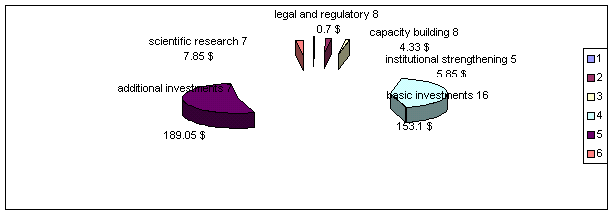
The proposed actions are provided with the reference to their scale (local, local – transboundary, and transboundary), as NCAP should identify types and nature of interventions that could have national or transboundary impacts.
In total, 51 actions the cost of which is 265.13 million USD are planned under this NCAP.
The actions can be distributed as follows (according to quantity and cost):
Figure 7. Scope of activities (amount and cost in million USD)
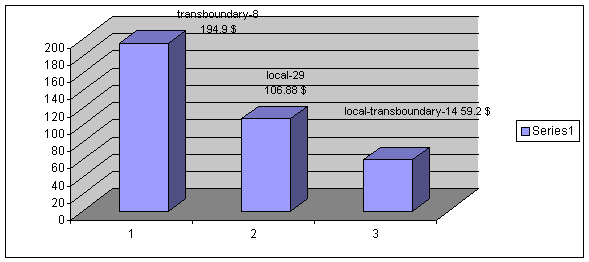
The objective of selection of long-term strategies and development of a set of environmental measures is to eliminate original causes and create optimal conditions for effective use of natural resources balanced with the community requirements, and to provide a necessary level of reproduction and protection of natural potential. The main objective of the strategy is to create favorable conditions for re-structuring and reduction of anthropogenic impact on the environment to environmentally acceptable level, support of life supporting functions of biosphere, to protect and reproduce natural resources. The following measures included in NCAP are necessary to achieve the objectives:
As far as the legal policies are concerned, the government will implement the main provisions of the National environmental policy, improve environmental management and use of natural resources system with consideration of commitments of Azerbaijan undertaken under international conventions and agreements.
The government will continue establishment of close contacts and will implement all necessary actions for coordination of joint effort of the Caspian countries for quick solution of disputable issues and ratification of Convention on legal status of the Caspian Sea and Framing Convention for Protection of Marine Environment of the Caspian.
Long-term strategy does not include implementation of certain legal and regulatory actions, as all the interventions of this type are considered urgent measures.
As for the institutional support and capacity building, three actions the cost of which is 5.45 million USD are included; in general they cover quality objectives of higher quality of seawater, surface water and ground waters.
Basic and additional investments are mainly allocated against water quality and life improvement objectives. 13 actions are planned, estimated investments total 134.95 million USD. Investments for the first objective (water quality) were not included, as they are to be identified during further studies.
The long-term strategy does not include actions of scientific research investments.
The strategy of long-term measures for elimination of regional causes depends on timely completion of structural changes that are presently in progress, in the following fields:
Improvement of economic and financial mechanisms of reproduction of natural resources;
Development of labor and service market in the field of use of natural resources;
System of incentives for the use of technologies that can save resources and power, wider use of secondary resources, higher degree of waste treatment;
Implementation of new technologies in all spheres of economic activity;
System of incentives for the development and implementation of effective environmental management systems in industry, including compliance with international standards like ISO 14000;
Isolation and rehabilitation of areas with dangerous alterations of environmental quality;
Gradual transition to international standards for technical processes and quality of the product.
Urgent measures to eliminate original causes include implementation of low cost actions. Among the low cost objective programs and projects with environmental and social feedback are the implementation of economic (market) mechanisms of environment protection and use of natural resources, improvement of environmental legislation and regulations, increase of public awareness of social necessity of environmental protection, as well as seeking ways to involve business structures and social organizations into environmental activities.
NCAP includes 30 actions/urgent measures with the budget of 129.43 million USD. Classification of actions/ projects of urgent measures in EQO’s by intervention categories covers the objectives of sustainable use of the Caspian and sustainability of the Caspian environment, including conservation of biodiversity (23 actions/projects with the budget of 212.18 million USD).
Implementation of the actions will allow rapid development and implementation of:
National environmental education strategy;
Methods of calculation of prevented environmental damage for all components of environment and environmental activities;
Development and distribution of methodic recommendations for setting traffic safety regulations, with consideration of environmental situation and transport pollution;
A set of regulatory documents that limit the environmental impact assessment;
Mechanism of attracting non-budgetary financing sources during implementation of environmental projects;
Methods of calculation of fines for pollution of offshore area of Azerbaijan (oil spills, discharge of oil products, drilling wastes, wastes from ships etc.);
Wide distribution of true and updated environmental information, support of public environmental movements, participation of NGO in the decision of environmental problems and implementation of environmental control and monitoring;
Higher effectiveness of state expertise, introduction of EIA procedures, establishment of a common state environmental monitoring system;
Support of activities on conservation of biodiversity, ecosystems and landscapes;
Establishment of an effective system of a continuous environmental education, formation of environmental culture and environmental perception.
The amount of environmental problems and problems of rational use of natural resources proves that Azerbaijan will have to carry out purposed long term work to solve these. As stated in NCAP, the government together with the public and international community intends to input maximum effort to prevent further pollution of air, soils and water of Azerbaijan, eliminate consequences of historical pollution and create favorable conditions to preserve the environment and biodiversity for future generations.
It’s necessary to say that there is a range of issues that can hinder successful solution of the above problems.
There are no political obstacles for implementation of NCAP at the republican level. All political issues are of regional character. They include the issues of the status of the Caspian, sharing water area and seabed between the coastal countries, development of common environmental management and system of use of natural resources of the Caspian (hydrocarbons, biomass etc.).
Main internal institutional obstacles derive from limited finances that could be allocated against environment protection. Other obstacles include lack of regulation of economic use of natural data systems, which leads to their (the systems’) damage and degradation. Environment protection institutional base is not well developed. The issue of environment does not meet appropriate consideration in the structure of decision-making. There is no common system of environmental monitoring, environmental expertise, environmental audit. Information access mechanisms are underdeveloped, cooperation between governmental and non-governmental organizations, movements and local communities is insufficient. This creates a background for poor feedback and inappropriate opinion of effectiveness of environment protection activities.
Unfortunately, recent improvement of economic indicators mainly derives from oil production industry that is a potential threat to environmental stability of the Caspian Sea and entire country, so this can also be considered as an indirect potential obstacle, and the measures should include the abovementioned potential threat.
Coastal zone was the most developed part of the country, where fuel and energy complex facilities were concentrated, as well as the metal, chemical and oil chemical industries, machine industry, instrument building and car building, light and food industries (mainly in Baku, Sumgayit, Ali-Bayramli, Salyan, Neftechala) with hundreds of thousands of employees.
Agriculture was also well developed in this zone (Khachmaz and Lenkaran), agricultural products were mainly exported.
General economy decline of 90’s caused fast decline of industrial production. Many plants ceased their activity, others work at ten to fifteen percent of their capacity.
Loss of agricultural market where input of vegetable growing was up to 800 thousand tn., fruit growing - about 100 thousand tn., growth of subtropical fruits and tea - about 15 000tn., winegrowing - above 300 thousand tn. etc., made plant growing fell into decay. The canneries of Khachmaz, Hudat, Guba, Gusara, Lenkaran, Astara etc. with total capacity over 30 million cans shut down the production.
This led to massive dismissals, decline in jobs and increase of social vulnerability of the population. The decline of economic and social development of the coastal area during the last decades had its impact on the condition of the environment. On one hand, this is the result of historic structural deformations of economy which was dominated by nature, resource and power consuming technologies, and related residual pollution of the environment; on the other hand, negative impact reduced (air emissions, sewage and discharges).
At the same time, reduction of life standard of population, no possibility for timely payment for power use (power supply, gas) put more pressure on environment, like deforestation, violation of norms of cattle grazing, illegal hunting and catch of birds and animals, pouching (which had the most negative impact on sturgeon).
Analysis of the present situation shows that traditional sectoral coastal planning cannot manage such negative processes as pollution, overuse, degradation and loss of unique ecosystems.
At present, there is no organizational and legislative system of coastal planning and development at national level. Therefore contradictions connected to overuse of coastal resources will intensify problems of social and economic development. There is a conflict between the use coastal resources and necessity to provide their long-term conservation, which creates negative attitude of the population to the environment, increases pressure on flora and fauna.
At present economic and financial capacities of the country are not sufficient for complete solution of the most important problems of the coastal zone and the Caspian.
Human and labor resources of Azerbaijan are sufficient to implement any environment protection projects. Scientific potential of the National Academy of Sciences and scientists of leading specialized institutes have the capacity of developing scientific, methodical, legal and the regulatory and technical documentation to implement nature protection activities, design buildings, facilities and carry out management. However, considering that the majority of future projects will be developed in cooperation with international organizations, taking into account integration of Azerbaijan into international community and gradual transition to internationally recognized standards, norms and regulations of project, regulatory and other documentation, wide implementation of new technologies and know how, most of our specialists and technicians would require special training, workshops and other types of teaching to update their knowledge (considering high technical knowledge of local personnel training will take only a few weeks). Probably there will be certain obstacles in this aspect but they can be considered insignificant.
In the nearest future financial provision of environment protection will be the main obstacle. Budget analysis shows that the costs environmental management up to 2005 will be increasing: from 4.3 to 10.9% of the budget. In 2005 the cost will be 75 billion manat, which is 1.2% of budget expenses. As environmental management includes forestry and fisheries, mining management, hydrometeorological monitoring and environmental safety, and considering that implementation of environmental programs requires significant investments, it is hard to see that during the first five years (period of urgent measures) the government will have the capacity to finance large programs.
At the same time, the government takes measures in the field of market economic policy that includes support of financial stability, balanced monetary and exchange policy with strict control of inflation which will create conditions to increase the flow of investments into environmental activities, up to 1.5 percent of the budget.
The main financial resource of implementation of NCAP is a complex of sources of financing programs and projects of environment protection and sustainable use of natural resources. The following internal sources of financing are included:
State budget (republican, municipal)- It supports establishment and functioning of areas with a limited use, administrative expenses, monitoring, scientific research activities, and sponsors purposed programs. Apart from direct financing of environmental activities, the budget will indirectly support direct investments (development budget) creating incentives for investments into rehabilitation of industries, which will raise indicators of environmental performance. The budget also finances development of social infrastructure.
The total expenses of the budget allocated against environmental activities in 2002 (including investments into purposed programs) carried out by MENR are 36,6 billion manat (7.62 million U.S. dollars) for about 0,9 percent of the budget. Item of expenditure of budget for funds-in-trust is 2,6 billion manat (0,54 billion U.S. dollars). That will be allocated against the implementation of programs on monitoring and environment protection, reproduction of sturgeon and afforestation.
The expected annual increase of budget financing gives a possibility to increase the scope of work on purposed programs and will partially satisfy investment requirements of actions and projects under NCAP. This will be mainly investment in regulatory and institutional strengthening, capacity building and scientific research activities and projects. In the field of basic investments the main mechanism of government participation in implementation of important environmental programs and projects will be carried out by means of grants, loans, financing interest rate, guarantee of environmental credits, shared financing of environmental projects and so on.
Environmental fund. The fund collects environmental taxes and payments. The aim of the fund is to sponsor and carry out environmental activities. Mechanism of financing includes payments for pollution in exchange to the environmental activities carried out by the pollutant. Due to the economy situation and low rates the budget of the environmental fund is quite limited. In the 2 001 the input in the fund was 391,8 million manat, the income for four months of this year is 73 million manat, while estimate was 1 billion manat per year.
The funds of ministries and budget of enterprises. The funds of the ministries and enterprises should play an important role in elimination of negative consequences of environmental impact as they are the main pollutants. Present financial and logistical situation does not allow to invest in programs, they are not able to eliminate the consequences of historical pollution.
Loans. Local banks do not eagerly invest into environmental protection actions. This could be explained by a limited financial base of the banks and their preference to invest into the projects where payback can be expected within a few months. As environmental projects tend to be long term and low pay back, banks are not interested in sponsoring this field yet.
The main mechanisms of state participation in environmental programs and projects: donations, loans, interest rates, underwriting of environmental credits, shared financing of environmental projects etc.
In the situation of low economic opportunities and financial deficit international financial organizations and sponsoring countries can play significant positive role in financing the economy, including environmental activities. In 1994-2000 the total investment into the economy of Azerbaijan was 5,5 billion U.S. dollars. Distribution of direct investments by sectors is given below in the table below.
Table 7.2.13 Direct investments into difference sectors of economy, millions of US dollars
|
Sectors |
1993 |
1994 |
1995 |
1996 |
1997 |
1998 |
1999 |
2000 |
Total |
|
1. Industry |
- |
44 |
162 |
467 |
916 |
1148 |
773 |
842 |
4352 |
|
Including oil industry |
- |
22 |
140 |
417 |
780 |
944 |
553 |
574 |
3440 |
|
2. Construction |
- |
25 |
20 |
32 |
104 |
154 |
29 |
31 |
395 |
|
3. Trade and services |
- |
45 |
21 |
23 |
74 |
100 |
55 |
17 |
335 |
|
4. Transferred and communications |
- |
4 |
4 |
6 |
21 |
37 |
38 |
17 |
127 |
|
5. Other (including environment) |
- |
32 |
11 |
12 |
40 |
41 |
42 |
45 |
223 |
As becomes clear from the above table, main investments were made into oil sector, however, share of non-oil sector is also significant. During this year’s 40 million U. S. dollars were invested into the environment protection and rational use of natural resources of the country.
Financing of environmental projects is made in the form of credit and grants. It is necessary to say that international financial organizations do not sponsor projects entirely, there should be other sources of financing and, as a rule, guarantee of the government of Azerbaijan is required.
Among financial institutes that solve many important problems including environmental, the following stand out:
Global environmental fund (GEF). The purpose of the fund is to provide financial assistance in four fields: reduction of greenhouse gases to prevent climatic changes, conservation of biological diversity, international waters and ozone layer.
Private funds. Finances of private funds can be used for both grant submission for environmental researchers, organization of seminars, preparation of thematic reports, and implementation of investments (venture fund).
Bilateral and multilateral agreements. The agreements provide the basis for sponsor countries to provide technical assistance, training and investments for the countries of Central and Eastern Europe. These programs are usually developed through organizations of the sponsor country and appropriate Azeri companies. Aid is usually provided through financing of agreed purchasing.
International financial institutes. The main function of the institutes is to mobilize funds with low expenses in international markets and transfer funds as loans to recipient countries. The main financial institutes are:
International Bank Of Reconstruction And Development (IBRD) that act only on the basis of state guarantees. In general IBRD provides credits for special projects in which the bank takes an active part at all stages (project identification, preparation, assessment, negotiations, implementation, control and identification of results).
European Bank Of Reconstruction And Development (EBRD) – this institute provides direct financing of projects. The main objective of EBRD is to provide consultations, loans and to guarantee the payback, provide support of market-oriented structures, to assist private initiatives in the Central and Eastern Europe. EBRD can finance projects on water supply components or chemical treatment of sewage. Credits exceed 5 million USD, credit term is no longer than 10 years.
Islamic Bank of Reconstruction and Development (IBRD). The bank also carries out direct financing of projects. The bank mainly finances projects under the Program of technical assistance to water supply system, power supply, road construction, agriculture and so on. Bank requires certain guarantees for the loan, as a rule, governmental guarantees.
European Bank of Investments. As a part of integration policy of EC, the bank finances projects under the Program of technical help of TACIS in the countries of the former USSR. The bank gives priority to environment, and finances maximum 50 percent of project expenses. The bank offers medium and long term credits. The bank works at nonprofit basis, and its loan interest rate is close to the rate at which it loans money at the market of capitals.
Table 7.2.14 External sources of financing
|
Name of organization |
Type of organization and financing |
Types of Caspian-related projects, possible limitations |
Minimum/ maximum possible assignments |
Application procedure |
Co-financing |
|
UK Embassy |
Development Fund |
The Fund financed non-Caspian projects |
Maximum 450-500,000 USD |
From June till January (depends on term of the project) |
|
|
Government of Japan |
Executive Agency (International Cooperation Agency of Japan) |
Purchase of equipment only |
About 5 million USD |
An official application of the government of Azerbaijan is required at least 2 years before the project |
100% financing |
|
Embassy of Japan |
Grants for main projects |
Any environmental projects Should be approved by the Embassy and the Ministry of Foreign Affairs of Japan |
Maximum 10 million yen |
- |
Possible |
|
Embassy of France |
Ministry of Economy, Finance and Industry |
Development of Feasibility Study Conditions: French specialists should develop the study |
The Ministry can cover the most expenses of the study |
- |
- |
|
Embassy of France |
Government of France |
Any environmental projects Conditions: French specialists should provide services |
The conditions will be negotiated |
-
|
-
|
To give NCAP a national status at the stage of approval, it is practical to recommend the government of Azerbaijan Republic to establish a National Committee for implementation of NCAP that includes representatives of all stakeholders: the Ministry of Ecology and Natural Resources, Milli Medjlis (parliament), Ministry of Economic Development, Ministry of Finances, Ministry of Agriculture, Ministry of Energetic and Fuel and other special authorities dealing with the environment protection, as well as large private companies, associations and business organizations, commercial banks, experts and scientists, nongovernmental organizations, public movements and people under impact .
The main organization responsible for implementation of NCAP is the Ministry of Ecology and Natural Resources, but management and administration of implementation process will be carried out separately from implementation of specific duties of the Ministry.
It is proposed to establish three key departments that will participate in management and administration of implementation of NCAP:
NCAP Coordination Council. It will include high rank officials, representatives of stakeholders, especially academic institutes, NGO, representatives of business sector that are prepared to provide independent support to NCAP.
The objective is to provide support to NCAP at the highest level, including directives and assistance to NCAP in all sectors.
Activity:
Regular NCAP progress meetings; information about importance of NCAP in various sectors;
Coordination of various types of activity and their development between sectors.
National Committee on NCAP or Implementation Group for NCAP. It will include small amount of people that have project and information management skills. The Committee is closely related to the main organization responsible for implementation, the Ministry of Environment, but it is also independent enough to provide objective assessment and carry out independent monitoring.
Objective- act as the focus point during implementation of NCAP
Activity:
Motivate and support implementing organizations in financing and implementation and so on;
Coordinate and propose of financial mechanisms for NCAP;
Assist in establishment of contacts between implementing organizations and appropriate financial mechanisms;
Collect and provide appropriation of all information about NCAP;
Control and assess the progress of implementation of NCAP, together with a new prepare an annual summary of NCAP implementation, and if necessary provide compliance of NCAP;
Report to appropriate groups about the progress of implementation of NCAP;
Prepare, publish and distribute information about NCAP;
Assist and extend cooperation in exchange between all groups working with NCAP.
Working group, that includes a few consultants working on the basis of short-term contracts that will assist National Committee in project management.
Objective- Provide experience and knowledge necessary for the National Committee especially in fund establishment and technical aspects of NCAP Implementation.
Collecting information in certain fields;
Independent monitoring to assess NCAP implementation in various fields;
General review and recommendations in certain fields;
Provision of necessary training, including preparation of proposals for grants in monitoring, as a part of support to the National Committee.
In addition to targets and interventions it is necessary to assess a range of more specific indicators that will provide a general picture and assess the positive role of expected interventions. The indicators will be based on expected results of implementation of certain projects. The priority and selection of projects is based on agreed expectations of the condition of the environment in the future. The indicators characterize many achievements on primary objectives as listed below. In addition to the planned indicators and intervention more certain indicators will be assessed, which can provide a detailed picture and assess a positive role of proposed interventions. The indicators are based on the data of expected implementation results for each project. The priority and selection of projects reflects an agreed view of expected status of the environment. The indicators characterize many achievements on primary objectives as listed below.
Table 8.2.15 Targets and expected results of EQOs
|
Expected results of environmental objectives |
Targets |
|
1. Sustainable economic use of the Caspian and coastal area
The implementation of new technologies and equipment will allow to continue development of the offshore oil fields with minimal risk and transport the product in a safest way. Development and implementation of CZCC loss to reduce environmental pressure on sensitive areas, allocate economic facilities, reduce pollution of surface, ground waters and sea water |
1- development and implementation of a plan of integrated coastal management by 2012 |
|
2- provide safety of exploration, production and transportation of hydrocarbons by means of the advanced technologies and modern equipment that allows to prevent pollution of biosphere by 2030 |
|
|
3- reduce impact of agriculture on the surface and ground waters by 2 007 by means of new agricultural technologies, establishment of new norms for cattle grazing . |
|
|
4- reduce pollution of the sea by domestic and industrial sewage in Baku and Sumgayit by 2012 |
|
|
II- Sustainability of the environment of the Caspian including conservation of biodiversity
Implementation of the project will increase the area of protected zones by a factor of 2,5; rehabilitation of spawning grounds of sturgeon and other valuable commercials species will provide commercial return of about 8 thousand ton; establishment of biological centers for breeding of rare and endangered species of fauna and forestation will create favorable conditions for sustainable use of resources of the Caspian and coastal area, along with the conservation of biodiversity of ecosystems |
1- establishment of a national park Shah Dag with affiliate in Yalama by 2007 |
|
2- rehabilitation of natural spawning grounds in Kura and Araks Rivers on the area exceeding 150 hectares by 2012 |
|
|
3- establishment of a biological center for reproduction of rare and endangered species with five affiliates in different areas by 2007 |
|
|
4- prevent degradation of coastal area, fix sands and eroded slopes by 2005 |
|
|
5- increase public awareness about value of biodiversity of the Caspian sea by 2005 |
|
|
6- development of guidelines for economic assessment and mechanisms of compensation of biodiversity loss by 2005 |
|
|
7. Increase capacity of sturgeon hatcheries up to 30 million per year by 2012 |
|
|
III- High quality of sea water, ground waters and surface waters
The implementation of the projects will create favorable conditions for fast reduction of pollution of sea water caused by domestic and the industrial discharges, increase recreation capacity of the coastal zone, rural population will use high quality drinking water. Cleaning of sea water will increase recreation potential |
1- quality of drinking water will improve in rural areas by 2012 |
|
2- regulation of industrial, municipal and agricultural discharge into the environment by 2007 |
|
|
3- reduced areas with polluted surface and ground waters of Absheron peninsula by 2012 |
|
|
4- higher quality of coastal waters of recreational zones in Yalama, Absheron and Lenkaran 2012 |
|
|
5- capacity building for emergency response and oil and chemical spill response onshore and offshore by 2007 |
|
|
IV- Sustainable combined use of the coastal area of the Caspian
Improvement of hydrological and biological regime of reserves and valuable wetlands will create conditions for the rehabilitation of wintering sites of migrating bird pieces, allow conservation of rare or endangered species |
1- introduction of feasible norms of recreation pressure on landscape complexes by 2007 |
|
2- improved hydrology for Sheehan and provision of sustainable use of wetlands of Kyzyl Agach reserve by 2007 |
|
|
3- establishment of Taurus complexes for 5 000 people (Yalama, ApsherThe on, Lenkaran) by 2012 |
|
|
4- opening of a Center Of Environmental Training in Baku with affiliate in Kuba by 2005 |
|
|
V- Higher life standard
Implementation of the planned actions is connected with general economic raise for the population of coastal area, new job opportunities, higher life standards, improved health conditions and wider range of medical service and use of medicines.
Construction of tourist complexes and development of ecotourism will create favorable conditions for recreation, as well as stimulate development of agriculture, food and processing industries |
1- rehabilitation of production potential and capacity of processing of agricultural products in coastal area by 2007 |
|
2- development of mechanism and creation of favorable conditions to attract investments into the local sectors of economy by 2005 |
|
|
3- introduction of measures for sustainable use of fisheries by 2012 |
|
|
4- organization of yearly sales in border area of coastal zone, improvement of trade exchange in the Caspian region by 2005 |
|
|
5- presentation project on ecotourism on the example of national park in Shah Dag by 2007 |
|
|
6- assistance to implementation of national health program by 2012 |
|
|
7- expansion of environmental education by 2005 |
|
|
8. Access to information and public participation in the development of NCAP |
A specific feature of present period is a higher role of nongovernmental sector at all levels of public activity. Significance of public participation in decision-making process on the most important environmental issues connected with the condition of the Caspian sea is acknowledged by all the stakeholders: population, public organizations and movements, private companies, enterprises and state authorities. Distribution of information about NCAP is one of the conditions of its successful implementation, as it will allow controlling implementation of the tasks and changes of the environment in general, and in the Caspian, in particular. The following organizations are responsible for the distribution of information: MENR, State Committee of Statistics, Ministry of Agriculture, Ministry of Public Health, State Committee of Land and National Academy of Sciences. All information is submitted to MENR, where it is processed in the following ways: use of information as a policy tool, analysis of NCAP implementation and development of further activities; use of information for public relations and public awareness of implementation of NCAP and planned policies; use of information for contacts and interaction between participants of implementation of the NCAP and regulate information exchange with local authorities.
To provide the public with detailed and reliable information is of high significance, as environmental threat derives from human mind, which is an information structure, therefore a way to change public perception is to change the information contained in the public mind. Therefore it is necessary to develop and implement new approaches to contents and organization of humanitarian and environmental information and to the work of mass media.
Main state policies in this field include:
Provision of environmental information to all social population groups in order to form environmental perception and environmental culture;
Information of possible ways of environmental performance of industrial and non-industrial activities;
Explanation of the economic aspects of links between the environment and society;
Distribution of information in mass media, publication of environmental literature, environmental training literature;
Organization of seminars, public presentations, demonstration projects, interviews for expression of public opinion on main environmental issues.
A LIST OF PRIORITY PROGRAMS AND PROJECTS UNDER THE NATIONAL ACTION PLAN FOR CONSERVATION AND SUSTAINABLE USE OF THE CASPIAN SEA
|
EQOs
|
Type of intervention |
Interventions/projects |
Responsible institution |
Priority level |
Scale |
Cost, billion manat |
|
Sustainable use of the Caspian sea and coastal areas |
Legislative/ Regulatory
|
1. Development of a law of Azerbaijan Republic ‘On complex coastal management’
|
ММ, MENR, MED, MEF, MA |
I
|
Local |
0.1 |
|
2. Development of a law of Azerbaijan Republic “On Environmental Impact Assessment”
|
MМ, MENR |
I
|
Local |
0.05
|
||
|
3. Improvement of legal base and standards on sustainable use of the Caspian Sea
|
CM, SOCAR, MED, MENR, FOC, NGO
|
I |
Local |
0.1 |
||
|
Institutional strengthening
|
4. Establishment of a special solid domestic and toxic waste management system |
MENR, FOC, SCCA
|
I
|
Local |
0.2
|
|
|
Capacity building
|
5. Development of programme of ecological standards enforcement during oil and gas exploration
|
SOCAR, FOC, MENR
|
I
|
Local Transboundary |
0.2
|
|
|
6. Capacity building for control of rational use of the Caspian resources
|
MENR, SCTE
|
I
|
Local |
1.3
|
||
|
7. Capacity building for services on prevention and elimination of consequences of natural and man-caused calamities |
MENR, CEE, MED, MIA, SOCAR, FOC, CBED |
I |
Local Transboundary |
2.0 |
||
|
|
Basic investment
|
8. Rehabilitation of natural spawning grounds in the delta of Kura river |
MENR, BTN, LEA
|
I
|
Transboundary |
10.0
|
|
9. Reconstruction of Ust-Kura, Ali-Bayramly and Varvarinski fish hatcheries
|
MENR, LEA
|
I I
|
Transboundary |
3.5
|
||
|
10. Prevention of sea pollution with oil discharge from old oil rigs of the Oil Rocks field |
SOCAR
|
I I
|
Local/ Transboundary |
ARR
|
||
|
Sustainable economic use of the Caspian Sea |
Basis investments |
11. Restoration of oil polluted fields of Absheron and South-Eastern Shirvan, planting of perrenial subtropic plants (olive-trees, 5000 ha) |
SOCAR, MA, MENR, FOC, LEA |
I |
Local/ Transboundary |
20.0 |
|
Additional investments |
12. Prevention of water pollution in Baku bay with waste waters. Reconstruction and expansion of Govsany waste water treatment plant |
BCEA, BSS |
I |
Local/ Transboundary |
180.0 |
|
|
13. Programme of ecotourism development in the coastal zone |
MENR, MYST, NGO |
I |
Local |
0.6 |
||
|
Scientific research
|
14. Development of a program and mechanism to attract investments into environment protection projects
|
MED, MF, MENR
|
II
|
Local |
0.1
|
|
|
15. Pilot studies and assessment of the possibility to use alternative sources of power for the coastal areas |
MENR, MED, MEF, FC, LEA |
II
|
Local |
5.0 |
||
|
16. Inventory of solid domestic and toxic wastes, development of programs of waste disposal and burial |
MENR, SCTE, SOCAR, MED, MA, LEA, FC |
I |
Local |
1.5 |
||
|
17. Assessment of recreational potential of the coastal area
|
MENR, MYST |
I |
Local |
0.1 |
||
|
|
|
|
|
|||
|
Sustainability of the Caspian environment, including conservation of biodiversity |
Legislative/ Regulatory
|
18. Development of a draft law of Azerbaijan Republic “On biosphere areas “
|
ММ, MENR
|
I
|
Local |
0.05
|
|
19. Development of a draft law of Azerbaijan Republic on SPNA at spawning fields at the Kura river (from Varvarinsli dam to Piraza settlement – length 56 km, square- 53 ha). |
CМ, MENR |
II |
Transboundary |
0.1 |
||
|
20. Development of a draft law of Azerbaijan Republic on SPNA at spawning fields at the Araks river (from Bagram-Tapa dam downstream, length- 11,6 km, square- 290ha) |
CМ, MENR
|
II
|
Transboundary |
0.1
|
||
|
Institutional strengthening |
21. Higher effectiveness of work in Shirvan Gyzyl Agach and Girkan reserves |
MENR, MYST
|
I
|
Local/ Transboundary |
0.3
|
|
|
Capacity building |
22. Qualified training in national parks and ecotourism management
|
MENR, MYST
|
I
|
Local |
0.23
|
|
|
23. Capacity building for better monitoring of environment protection activities
|
MENR
|
I
|
Local |
0.25
|
||
|
Basic investments
|
24. Establishment of Shirvan National Park |
CM, MENR |
I |
Local |
2.5 |
|
|
25. Establishment of Girkan National Park |
CM, MENR |
I
|
Local |
5.0 |
||
|
26. Prevent degradation and desertification of the coastline of the Caspian – fix sands and prevent erosion by means of planting perennial species (Yalama, Divichi, Gilyazi, Absheron, Garadag, Bandovan, Lenkaran and Astara, 6000 hectares)
|
MENR, MED, LEA |
I |
Local/ Transboundary |
6.0 |
||
|
27. Construction of waste treatment facilities in Baku
|
MENR, BCA, LEA
|
II |
Local |
4.0
|
||
|
28. Conditions for sustainable use of the wetlands of Gyzyl Agach natural reserve
|
MENR, LEA
|
I
|
Transboundary |
0.7
|
||
|
29. Improvement of hydrological and biological regime of Divichi estuary, as of the zone inhabited by rare and endangered waterfowl species |
MENR, LEA |
I I |
Transboundary |
0.4 |
||
|
Additional investments |
30. Establishment of a biological centre of captive breeding of rare and endangered species of fauna
|
MENR, LEA
|
I |
Local |
0.5
|
|
|
Scientific research |
31. Researches on desertification process in the coastal zone |
NAS, BSU
|
I
|
Local |
0.25
|
|
|
High quality of sea water, surface waters and ground waters |
Legislative/ Regulatory |
32. Development of national standards for vessels, rigs, ports and terminals that discharge sewage directly into the Caspian |
MENR, SOCAR, MEF, CEE
|
I
|
Transboundary |
0.1 |
|
Institutional Strengthening/ Capacity building |
33. Development and implementation of a set of scientific and technical actions for cleaning and improvement of coastal areas of saline lakes of Apsheron peninsula |
BCA, SOCAR, LEA, NAS, RI
|
I I
|
Local/ Transboundary |
4.5
|
|
|
Basic investment
|
34. Cleaning of Baku bay |
MENR, BCA, SOCAR, LEA
|
I
|
Local/ Transboundary |
6.0
|
|
|
35. Reconstruction of Mardakan- Shuvelyan treatment plant |
MED, LEA, BSS |
I I |
Local/ Transboundary |
ARR |
||
|
36. Reconstruction of Sumgayit treatment plant |
MED, LEA, SSSD |
II
|
|
ARR
|
||
|
Additional investments
|
37. Development of technologies that allow to collect oil from natural fountains, from the surface soils and water |
SOCAR, MENR, NAS, RI
|
II
|
Local/ Transboundary |
0.1
|
|
|
Scientific research
|
38. Development of treatment and disposal techniques for industrial and domestic wastes, including recycling |
NAS, RI |
I I |
Local |
0.1 |
|
|
Sustainable combined use of the coastal environment of the Caspian |
Legislative/ Regulatory
|
39. Improvement of legal and standard regulatory acts of coastal zone management
|
CМ, MENR, LEA
|
I
|
Local |
0.1
|
|
Basic investment
|
40. Establishment of recreation complexes in the coastal zones (for 5000 people)
|
PC, MYST |
I I |
Local |
25.0 |
|
|
Additional investment
|
41. Establishment of ecotourism centres in the coastal zones |
MENR, MYST
|
I I
|
Local |
0.45
|
|
|
Scientific researches |
42. GIS development in the coastal zones |
MENR, SCLRC, LEA |
I |
Local |
0.7 |
|
|
Higher life standards |
Institutional strengthening
|
43. Qualitative improvement and provision of wide access to medical services in the coastal zones |
MPH |
I |
Local |
0.1 |
|
44. Establishment of three regional centres of professional training for able-bodied citizens
|
MLSP
|
I I
|
|
0.75
|
||
|
Capacity building
|
45. Development of target programmes on traditional spheres of economy |
MED, CM, LEA, MLSP |
II |
Local |
0.1 |
|
|
46. Development of target programs to inform public about the problems of the Caspian Sea
|
ME, MENR |
I
|
Local |
0.10 |
||
|
47. Development and approbation of curriculum on the problems of the Caspian preservation
|
ME, NAS |
I |
Local |
0.15 |
||
|
Basic investments
|
48. Improved quality of drinking water of rural areas of the coastal zones
|
MMMWS, LEA
|
I I
|
Local |
50.0
|
|
|
49. Construction of treatment plants in Hudat, Divichi, Ali-Bayramly and Astara |
SCCA, LEA |
I I |
Local/Transboundary |
20.0 |
||
|
Additional investments
|
50. Repair of existing irrigation network
|
MMWS, MA, LEA, PC |
I I |
Local |
7.5
|
|
|
Scientific research
|
51. Marketing of local goods in order to expand regional market
|
MED, LEA |
I |
Local/Transboundary |
0.1 |